
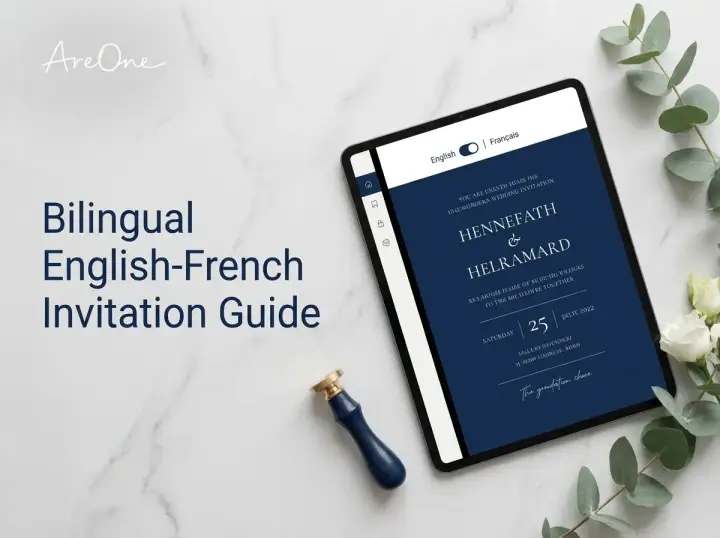
TL;DR: Crafting the perfect bilingual English French wedding invite requires thoughtful layout choices, careful wording translations, and clear digital RSVP options to ensure every guest feels welcomed.
Setting the Stage for Your Bilingual English French Wedding Invite
Planning a wedding across two beautiful cultures is a breathtaking journey. Creating a seamless bilingual English French wedding invite ensures all your guests feel equally cherished right from the start. Whether you have family flying in from Paris or friends tuning in from Montreal, your digital invitation sets the tone for the entire celebration. Navigating two languages gracefully becomes essential to honoring both sides of your new family tree.
Blending languages can sometimes feel like a delicate balancing act. You want your design to look elegant, your wording to sound natural, and your guests to easily find the information they need. A well-crafted multicultural wedding invite acts as a welcoming bridge between your loved ones. It communicates respect and excitement to everyone on your guest list.
We know that translating heartfelt sentiments is about more than just swapping words. It requires capturing the right cultural nuance. By the end of this guide, you will have all the tools, templates, and inspiration needed to confidently send out your bilingual English French wedding invite.
Who Needs a Multicultural Wedding Invite? (Common Scenarios)
You might wonder if creating a dual-language invitation is strictly necessary for your event. The short answer is yes, especially if a significant portion of your guest list speaks a different primary language. A bilingual English French wedding invite is popular among modern couples with diverse backgrounds.
Consider the classic expat scenario. You might live in the United States, but your partner’s extended family resides in France, Belgium, or Switzerland. Even if those overseas relatives speak conversational English, receiving an invitation in their native French shows immense thoughtfulness. It immediately makes them feel valued and considered.
Another common scenario involves regional blending, such as couples from Canada where English and French naturally intertwine. For elderly guests, such as grandparents, a bilingual approach is not just a nice gesture; it is a vital accessibility feature. They need to understand the venue details and timelines without confusion. If you want more background on these dynamics, check out our guide to clear, elegant bilingual wedding invitations.
UX Rules: Layout, Order, Typography, and Clarity
When designing a bilingual English French wedding invite, User Experience (UX) is your best friend. UX simply means making your invitation easy to read and navigate. The biggest challenge with dual-language invites is avoiding visual clutter. Too much text can overwhelm the reader, causing them to miss important details.
First, prioritize clear typography. Use legible fonts, especially for critical details like dates, times, and locations. While sweeping cursive scripts look romantic for your names, they can be difficult for older eyes to decipher. Pair a beautiful script for headings with a clean, modern sans-serif font for the heavy lifting of your informational text.
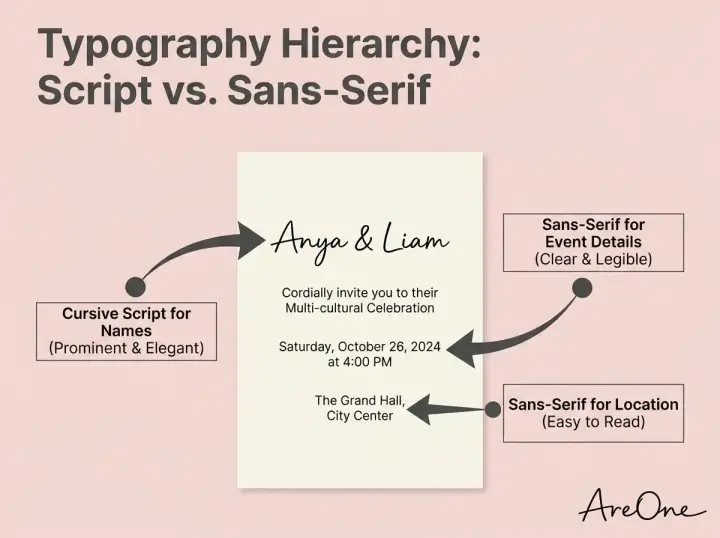
Consistency is also key. If you decide that English will be the primary language featured first, maintain that exact order across every single touchpoint. Consistency prevents cognitive overload. Ensure your line spacing provides enough breathing room between the two languages. French text is often 15% to 20% longer than its English counterpart, so your layout must remain flexible enough to accommodate both elegantly.
Side-by-Side vs. Stacked vs. Language Toggle
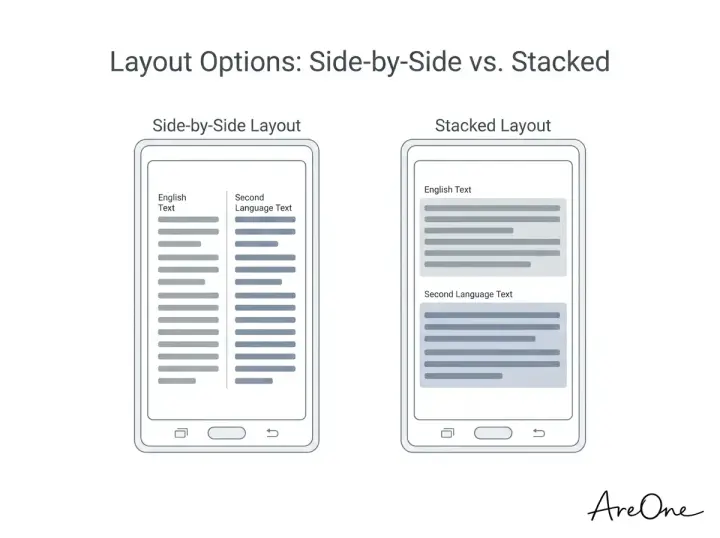
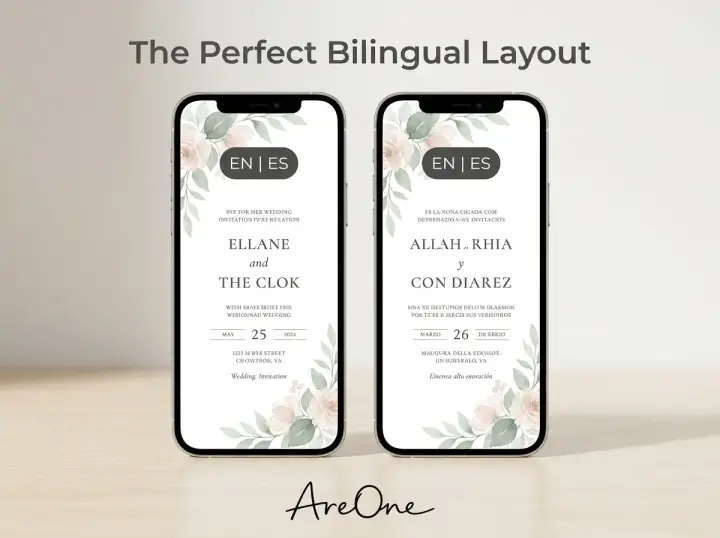
How do you actually arrange the text on the page or screen? You generally have three main options for your bilingual English French wedding invite: side-by-side, stacked vertically, or a dynamic language toggle.
The side-by-side approach works beautifully for printed landscape cards. You place English on the left and French on the right, separated by a delicate vertical line. However, this format translates poorly to mobile screens, where text becomes microscopic and frustrating to zoom in on.
The stacked approach places one language directly above the other, often using different colors or slight font variations to distinguish between them. This is effective for mobile viewing. Yet, the absolute best solution for a digital invite is the language toggle.
With a dynamic toggle, guests simply select 'English' or 'Français' when they open the invite. The screen instantly adapts, providing a personalized, clean experience. To learn more about setting this up, review our multilingual wedding website UX rules.
The Essential Translation Checklist
Literal translation is the enemy of a beautiful bilingual English French wedding invite. Using automated tools like Google Translate often results in awkward phrasing that lacks warmth and cultural awareness. You need a reliable translation checklist to ensure every detail is handled with care.
Before finalizing your text, cross-reference your wording against this comprehensive checklist:
- Names and Titles: Never translate proper first names. 'William' stays 'William,' not 'Guillaume.' However, do translate honorifics carefully. 'Mr. and Mrs.' becomes 'M. et Mme' in French.
- Venue Addresses: Keep street names in the native language of the venue's country. Translating 'Rue de la Paix' to 'Peace Street' will only cause the GPS to fail and guests to get lost.
- RSVP Instructions: Ensure the call to action is culturally relevant. 'RSVP' originates from French (Répondez s'il vous plaît), making it universally understood, but the surrounding instructions must be tailored.
- Dress Codes: Nuances matter. 'Black Tie' loosely translates to 'Tenue de soirée' or 'Cravate noire,' but providing specific visual examples on your website helps bridge any gaps.
Formatting Dates and Times Correctly
Dates and times deserve their own spotlight because they are the number one cause of guest confusion. The United States formats dates as Month/Day/Year. France, and most of Europe, formats dates as Day/Month/Year.
If you write '04/05/2026' on your bilingual English French wedding invite, your American friends will book flights for April 5th, while your French relatives will arrive on May 4th. To prevent this disaster, always spell out the month using letters. Write 'April 5, 2026' and '5 avril 2026'.
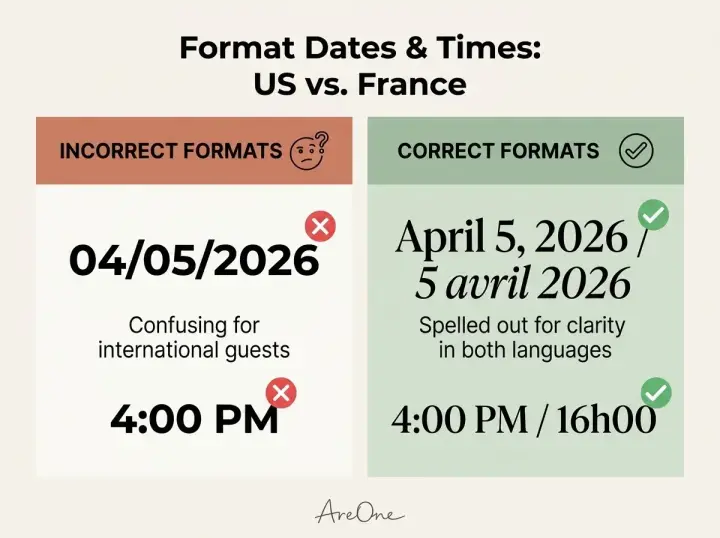
Time formats also differ. English relies on the 12-hour clock with AM and PM markers. French formatting utilizes the 24-hour clock. An evening ceremony at 6:00 PM should be written as '18h00' in French. Getting these small details right showcases your attention to guest comfort.
English–French Invitation Wording Examples to Copy-Paste
Finding the exact right words can feel daunting. To make your life easier, we have compiled several wording examples for your bilingual English French wedding invite. You can copy, paste, and adapt these to fit your unique celebration.
Browse invitation layouts that fit your plan.
Compare layouts for schedules, travel details, guest guidance, and RSVP information before choosing one for your invitation.



French wedding etiquette is historically quite formal, often leaning heavily on parental announcements. However, modern couples frequently opt for a more relaxed, inclusive tone. Choose the style that best reflects your personality and the vibe of your event.
Traditional and Formal Wording
If you are hosting an elegant, classic affair where parents are traditionally issuing the invitations, this wording strikes the perfect respectful tone.
English Example:
Mr. and Mrs. Robert Smith and M. et Mme Laurent Dubois
request the honor of your presence
at the marriage of their children
Emily Grace and Thomas Alexandre
Saturday, the fifth of September, two thousand twenty-six
at four o'clock in the afternoon
The Grand Chateau, Paris, France
Dinner and dancing to follow.
French Example:
M. et Mme Robert Smith ainsi que M. et Mme Laurent Dubois
ont l'honneur de vous faire part du mariage de leurs enfants
Emily Grace et Thomas Alexandre
Le samedi 5 septembre 2026
à 16h00
Le Grand Château, Paris, France
La cérémonie sera suivie d'un dîner et d'une soirée dansante.
Modern and Casual Wording
For a contemporary couple hosting a more relaxed gathering, omitting the parental announcement and inviting guests directly feels warm, intimate, and modern.
Need a faster RSVP flow?
Use AreOne to collect guest replies, meal choices, and reminders in one clean workflow.
English Example:
Together with their families
Emily and Thomas
invite you to celebrate their wedding day
September 5, 2026 | 4:00 PM
The Grand Chateau, Paris, France
Let's eat, drink, and be married!
French Example:
Entourés de leurs familles
Emily et Thomas
vous invitent à célébrer leur mariage
Le 5 septembre 2026 | 16h00
Le Grand Château, Paris, France
Venez fêter, manger et danser avec nous !
Helpful Phrases Translation Table
Here is a quick reference table of essential phrases you might need for your multicultural wedding invite.
| English Wording | French Translation | Usage Context |
|---|---|---|
| Save the Date | Réservez la Date | Pre-invitation announcements |
| Reception to follow | Réception à suivre | Post-ceremony information |
| Kindly reply by | Réponse souhaitée avant le | Setting your RSVP deadline |
| Adults only reception | Réception réservée aux adultes | Communicating guest restrictions |
4 Common Cultural Pitfalls to Avoid
Even with the best intentions, couples can stumble when blending cultures. When creating your bilingual English French wedding invite, watch out for these four common mistakes that can disrupt the guest experience.
1. Using the Wrong Form of 'You'
The French language has two forms of the word 'you'. 'Tu' is informal and used only for singular, very close friends or family. 'Vous' is formal, used for groups, elders, or people you do not know intimately. On a wedding invitation, you must always use 'Vous' (e.g., Nous vous invitons). Using 'Tu' will read as inappropriate to traditional French speakers. If you are unsure about language nuances, consulting resources like Brides etiquette guide is helpful.
2. Assuming Shared Traditions
Do not assume your French guests understand American wedding traditions, or vice versa. For example, bridal showers and rehearsal dinners are very American concepts. If you are inviting French guests to these secondary events, use the invitation suite to briefly explain what the event entails so they know what to expect.
3. Disconnected Digital Experiences
A beautiful bilingual invite loses its magic if the guest clicks the RSVP button and lands on an English-only form. The transition from your digital invitation to your RSVP must be completely fluid. Utilizing a smart RSVP tracker that detects or retains the user's language choice is critical for a smooth user journey.
4. Overstuffing the Main Invite
Attempting to cram every single detail—directions, hotel blocks, registry links, and dress codes—onto the main face of the invite is a huge mistake. Multiply that text by two languages, and you have a messy, unreadable document. Keep the main invite clean. Move the heavy logistical details to an external digital hub.
Integrating Your Invite With a Bilingual Wedding Website
The smartest way to keep your bilingual English French wedding invite looking pristine is to pair it with a comprehensive digital hub. A bilingual wedding website acts as the central brain of your event, giving you unlimited space to communicate with your guests.
When you use digital platforms to manage your event, the main invitation only needs to hit the absolute essentials: Who, What, When, and Where. At the bottom of the digital card, a simple button reading 'Visit our website for details / Visitez notre site pour plus de détails' does all the heavy lifting.
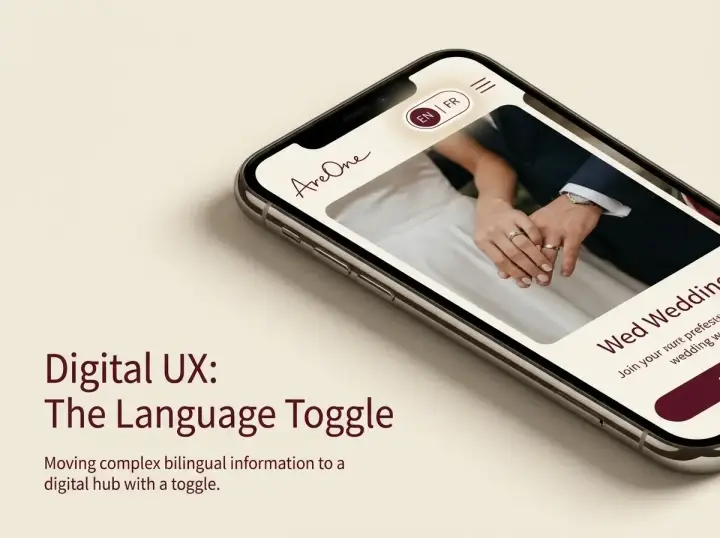
Once guests arrive on the site, they can toggle between English and French. They can read your love story, browse the local travel accommodations, and review the menu options in their preferred language. This dual-language ecosystem shows profound respect for your diverse guest list while keeping your aesthetic elevated. Ready to see how beautiful this can look? Browse our elegant digital templates designed specifically for multicultural couples.
Saying "Oui" to the Perfect Bilingual English French Wedding Invite
Designing a multicultural celebration is an extraordinary opportunity to celebrate the blending of two unique worlds. From perfecting the layout to mastering the delicate nuances of translated phrasing, every small choice you make paves the way for a warmer, more inclusive gathering.
Your invitations are the very first glimpse your loved ones will have into your special day. By prioritizing clear user experience, respecting cultural formatting, and utilizing dynamic digital tools, you guarantee that nobody feels left behind. Whether they say "Yes" or "Oui," your guests will arrive feeling thoroughly informed and valued.
Bridging two languages does not have to be a stressful logistical puzzle. With the right platform, it becomes a joyful creative process that honors your shared future. It is time to embrace the beauty of your diverse family and send out a bilingual English French wedding invite that speaks their language.
Frequently Asked Questions
Find quick answers to common questions about this article.

No approved comments yet.