

TL;DR: Building a flawless multilingual wedding website requires intuitive language toggles, careful translation of dates and locations, and thoughtful design to ensure every international guest feels perfectly accommodated.
Start With Language Choice and Clear Navigation
Who Multilingual Invites Are For: Common Scenarios
A multilingual wedding website needs more than translated text. Guests should be able to switch languages, read dates and addresses without ambiguity, and use the RSVP flow on a phone.
That matters when one guest list includes older relatives, international guests, and households that read different languages. For Arabic or another right-to-left language, check text direction, date formatting, and button alignment before sharing the link.
The sections below cover language selection, translation checks, and layout decisions that prevent guests from missing essential information.
The first common scenario involves expat couples living abroad. If you relocated for work or study and met your partner there, your guest list likely features a blend of your hometown friends and your new local community. Providing information in both languages shows deep respect for both sides.
Another frequent scenario is the blending of bilingual households. Perhaps both families live in the same country, but one family speaks predominantly Spanish at home while the other speaks English. A thoughtful bilingual wedding website bridges this domestic gap beautifully.
Finally, destination weddings practically demand dual-language communication. If you are flying your guests to a romantic villa in Tuscany, they will need navigational instructions, hotel recommendations, and transport details.
Providing these complex travel logistics in a language they understand prevents missed flights, lost guests, and frantic text messages on the morning of your ceremony.
UX Rules: Layout, Order, Typography, and Clarity
When you start designing your multicultural wedding invite, treating both languages with equal visual importance is a fundamental design rule. You never want one group of guests to feel like an afterthought.
Typography plays a massive role here. If your two languages use different alphabets—such as English and Arabic, or French and Japanese—you must select web-safe fonts that support both character sets seamlessly.
Consistency in font weight and sizing keeps the design cohesive. Do not make the English text bold and massive while shrinking the secondary language into tiny, hard-to-read italics.
White space is your best friend. Multiple languages mean more text on the screen. Give your paragraphs ample room to breathe. Cluttered screens overwhelm users, leading to missed RSVP deadlines and confused guests.
According to usability experts like the Nielsen Norman Group, placing a clear, easily identifiable language selector at the top right of your interface is a universal standard that users intuitively look for.
Evaluating Layouts: Side-by-Side vs Stacked vs Language Toggle
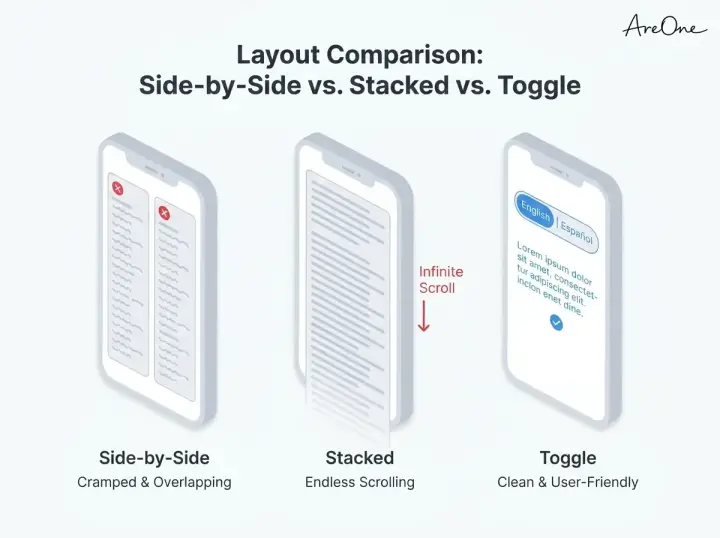
How you arrange the text determines whether your guests have a relaxing reading experience or a frustrating one. There are three primary ways to display dual languages online.
The side-by-side layout works wonderfully for printed paper but struggles heavily on digital screens. When squeezed onto a narrow mobile phone display, side-by-side columns become virtually impossible to read without zooming and panning.
The stacked approach involves placing the primary language first, followed immediately by the translation underneath. While this works for short sentences like an overarching welcome message, it creates endless scrolling for longer sections like travel itineraries.
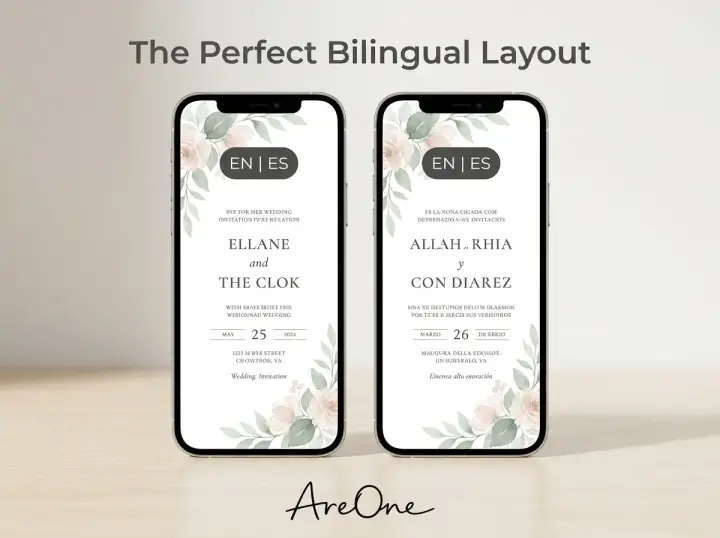
a practical approach for a modern interface is the language toggle. A toggle button allows the user to click a simple 'EN / ES' or flag icon, instantly transforming the entire interface into their preferred language.
| Layout Type | Best Used For | UX Impact | Mobile Friendliness |
|---|---|---|---|
| Side-by-Side | Printed invitations and wide desktop displays. | Can feel cluttered if text length varies significantly. | Very Poor. Requires awkward zooming on phones. |
| Stacked | Short, impactful statements or single-page announcements. | Forces users to scroll past text they cannot read. | Moderate. Legible, but creates excessively long pages. |
| Language Toggle | Comprehensive digital platforms and complex itineraries. | Clean, personalized, and highly professional. | Excellent. a strong default for modern design. |
Browse invitation layouts that fit your plan.
Compare layouts for schedules, travel details, guest guidance, and RSVP information before choosing one for your invitation.



Using a dynamic toggle ensures your templates remain sleek and modern, without overwhelming the user with a massive wall of text.
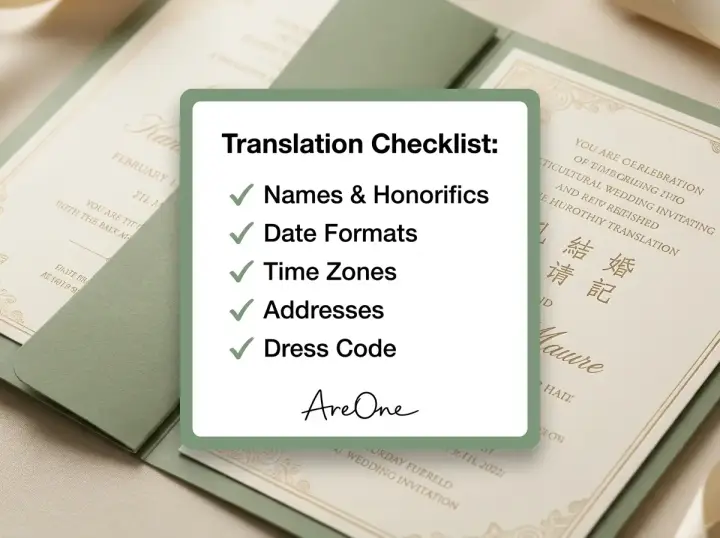
The Essential Translation Checklist: Names, Honorifics, Dates, and Addresses
Literal word-for-word translation is rarely effective. Cultural nuance matters just as much as grammatical accuracy. You must audit specific data points to ensure they make sense in the target region.
Before publishing your digital portal, run through this comprehensive translation checklist to catch subtle formatting errors that machine translators often miss.
- Names and Honorifics: Do not translate proper names. However, adjust titles appropriately. 'Mr. and Mrs.' translates to 'Monsieur et Madame' in French, but in Spanish, 'Don and Doña' might carry a more respectful, traditional weight depending on the region.
- Date Formats (Crucial): Americans use MM/DD/YYYY. Most of the rest of the world uses DD/MM/YYYY. If your wedding is on 05/06/2026, American guests read May 6th, while European guests read June 5th. Always write out the month alphabetically to prevent catastrophic scheduling errors.
- Time Formats: Specify time zones clearly. Decide whether your international audience prefers the 24-hour clock (15:00) or the 12-hour clock (3:00 PM).
- Physical Addresses: Keep the destination country in the original language or internationally recognized English format to help taxi drivers and postal workers. Provide clear Google Maps links rather than just text.
- Dress Code Nuances: 'Black Tie' has different connotations globally. Provide visual examples or highly descriptive text to ensure guests understand the exact level of formality expected.
Copy-Paste Examples for Your Multicultural Wedding Invite
Staring at a blank screen while trying to draft the perfect bilingual message is stressful. To help you maintain the right tone, we have prepared robust wording examples you can easily adapt.
These templates balance warmth, clarity, and logistical precision. Simply copy, paste, and adjust the bracketed information to fit your unique celebration.
Recommended ReadingBilingual Wedding Invitations: How to Make Them Clear & Elegant →Example 1: The Formal Traditional Approach (English / Spanish)
This wording is perfect for elegant, traditional ceremonies where older family members expect a high level of respect and formal structure.
English Version:
'Together with their families, [Partner A] and [Partner B] joyfully request the honor of your presence at their wedding celebration. The ceremony will take place on Saturday, the twelfth of September, two thousand twenty-six, at four o'clock in the afternoon. A reception featuring dinner and dancing will immediately follow.'
Spanish Version:
'Junto con sus familias, [Partner A] y [Partner B] tienen el honor de invitarles a la celebración de su matrimonio. La ceremonia tendrá lugar el sábado, doce de septiembre de dos mil veintiséis, a las cuatro de la tarde. A continuación, ofreceremos una recepción con cena y baile.'
Notice how the Spanish version uses 'tienen el honor de invitarles', which perfectly captures the elevated, respectful tone required for formal Hispanic events.
Example 2: The Modern Casual Approach (English / French)
If your vibe is a relaxed weekend party or a modern minimalist gathering, drop the heavy formalities and speak directly to your friends.
English Version:
'We are tying the knot! Join [Partner A] and [Partner B] for a weekend of love, laughter, and incredible food. We cannot wait to celebrate our next chapter with our favorite people. Grab a drink, find your seat, and let's party.'
French Version:
'Nous nous marions ! Rejoignez [Partner A] et [Partner B] pour un week-end d'amour, de rires et de gastronomie. Nous avons hâte de célébrer ce nouveau chapitre avec nos personnes préférées. Prenez un verre, installez-vous et que la fête commence.'
This translation captures the lively, joyous essence of the original text without sounding stiff or overly translated.
4 Common Cultural Pitfalls to Avoid
Even with the best intentions, navigating a bilingual digital project presents unique challenges. Avoid these major stumbling blocks to guarantee a flawless experience.
Mistake 1: Blindly Trusting Machine Translation
Using automated software to translate your romantic copy is risky. While tools are great for rough drafts, they completely miss cultural idioms, tone, and localized phrasing.
For instance, an automated tool might translate 'Save the Date' literally, which sounds absurd in many languages. Always have a native speaker review your final text to ensure the warmth and emotion remain intact.
Mistake 2: Cluttering the RSVP Questionnaire
Need a faster RSVP flow?
Use AreOne to collect guest replies, meal choices, and reminders in one clean workflow.
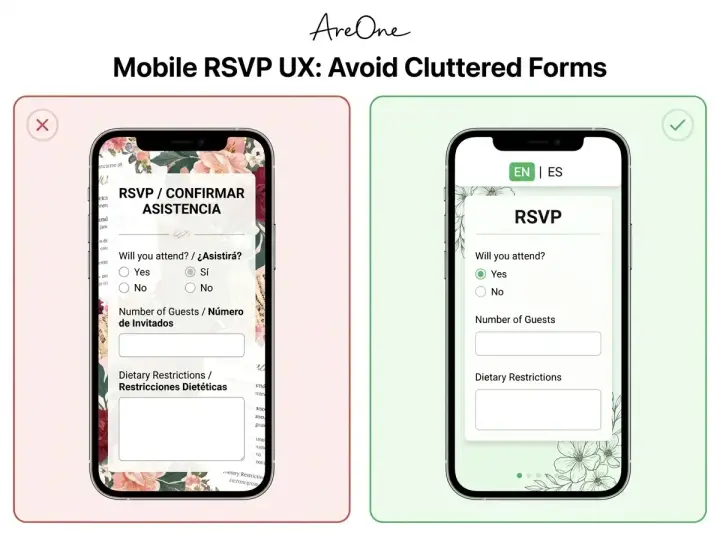
When collecting guest responses, asking questions in two languages simultaneously creates visual chaos. A cluttered form leads to abandoned responses and inaccurate meal counts.
Instead, rely on a smart RSVP system that detects the user's selected language and presents the meal choices, song requests, and attendance questions exclusively in that language.
Mistake 3: Ignoring Local Custom Differences
Different cultures handle gift-giving differently. While a traditional registry is common in the United States, many European and Asian cultures prefer monetary gifts in envelopes at the reception.
If you include registry links, add a gentle, culturally sensitive note in the respective language explaining your preferences. Etiquette experts from The Knot emphasize framing gift requests delicately based on the audience's background.
Mistake 4: Overlooking the Mobile Experience
Your younger guests will view your details almost on their smartphones. If you choose a stacked layout, your mobile page will stretch infinitely.
Guests will give up scrolling before they find the hotel block information. Always preview your layout on a physical mobile device before hitting publish. Ensure the language toggle is sticky and accessible from the top menu at all times.
Speaking the Language of Love
Before sharing the link, test the language selector, dates, venue address, RSVP buttons, and mobile layout in each language. Ask someone who reads the second language to check names, honorifics, and directions.
Frequently Asked Questions
Find quick answers to common questions about this article.
No approved comments yet.