
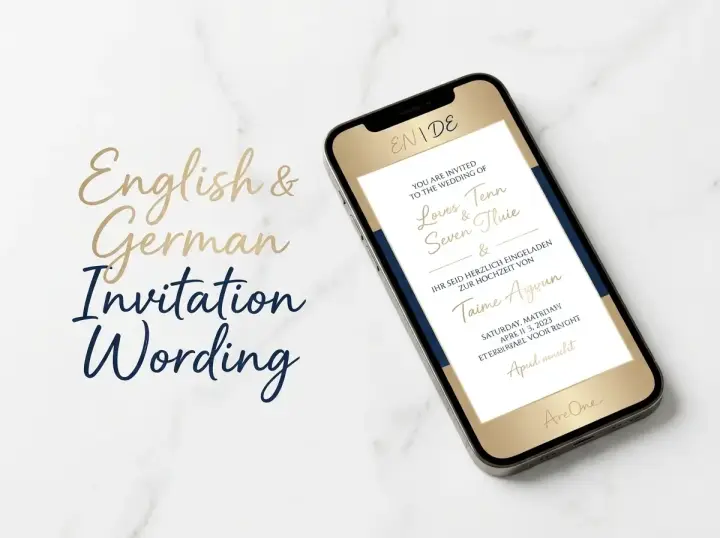
TL;DR: Creating a flawless bilingual English German wedding invite requires careful attention to layout, clear formatting choices, and culturally accurate translations so every guest feels equally welcomed.
Setting the Stage for a Multicultural Celebration
Planning a cross-cultural celebration brings families together from across the globe, uniting different traditions and languages. Naturally, communicating important details to all guests can feel slightly overwhelming. You want everyone to understand the venue, timing, and dress code without causing any confusion or anxiety.
When you craft your bilingual English German wedding invite, the goal is to weave two distinct languages into one beautiful, cohesive design. A well-designed invitation ensures no one feels like an afterthought. Rather, both sides of the family experience the same joy and anticipation when opening your message.
In this guide, we explore exact wording samples, proven layouts, and essential formatting rules to make your event spectacular. If you approach the design strategically, your stationery becomes a beautiful reflection of your unique love story.
Who Multilingual Invites Are For (Common Scenarios)
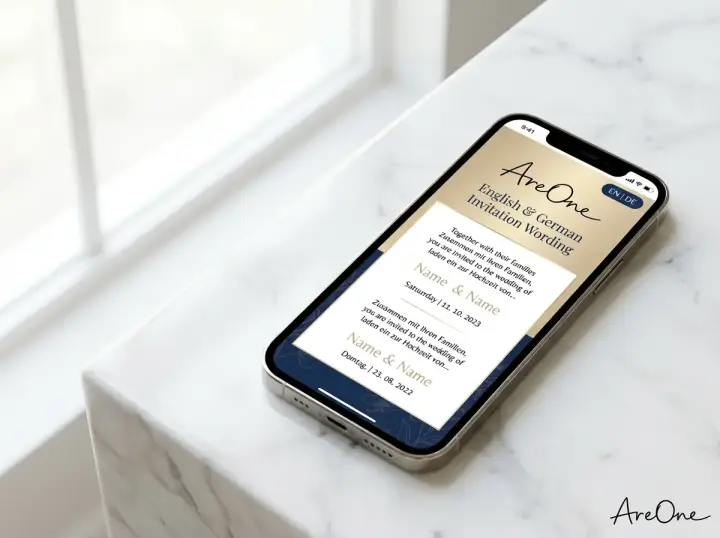
Couples navigating international relationships often face unique logistical hurdles. Whether you are an American expatriate living in Berlin, or a British-German couple hosting a destination weekend in the Austrian Alps, your guest list is inherently diverse. A digital multicultural wedding invite bridges the critical gap between different linguistic backgrounds.
It eliminates the friction of navigating foreign terms for elderly relatives or friends traveling from abroad. Consider a scenario where half of the attendees fly in from Frankfurt, while the other half drives in from Chicago. Sending exclusively English details alienates the German speakers, while a strictly German card confuses the Americans.
Providing a unified communication method is the absolute most hospitable approach you can take. Beyond geographical distance, linguistic inclusivity represents a profound sign of respect. Merging two languages signifies the merging of two families. If you need a comprehensive overview of how to plan your broader strategy, read our guide to clear, elegant bilingual wedding invitations.
UX Rules: Layout, Order, Typography, and Clarity
Designing for two languages demands a strict adherence to user experience principles. If you clutter a small screen or a physical card with too much text, readers will immediately feel lost. Typography plays a massive role in guiding the eye efficiently across the page.
You should establish a clear visual hierarchy by manipulating font sizes, weights, and spacing. Distinguishing the primary language from the secondary language through subtle design choices prevents severe cognitive overload. Consistency remains your greatest ally throughout the entire design process.
If English appears on the left and German on the right in the main header, you must maintain that specific orientation throughout the entire document. Do not switch the order arbitrarily. Guests unconsciously train themselves to look at a specific section of the page for their native tongue. For an in-depth breakdown of digital readability, review our multilingual wedding website UX rules.
Side-by-Side vs. Stacked vs. Language Toggle
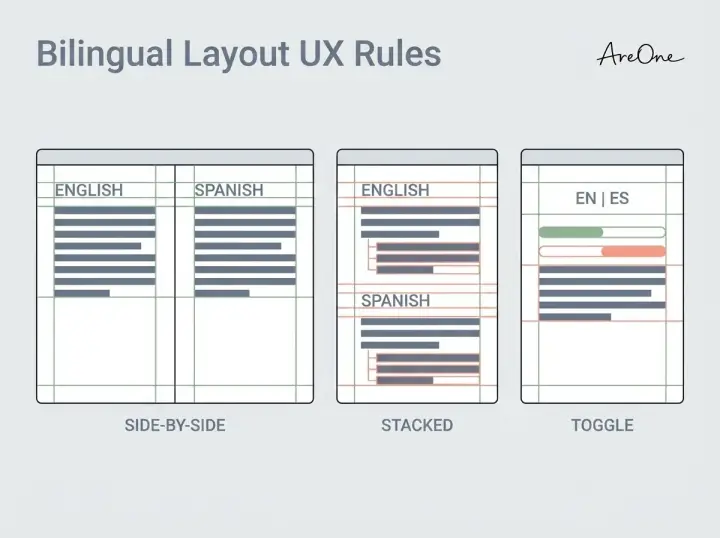
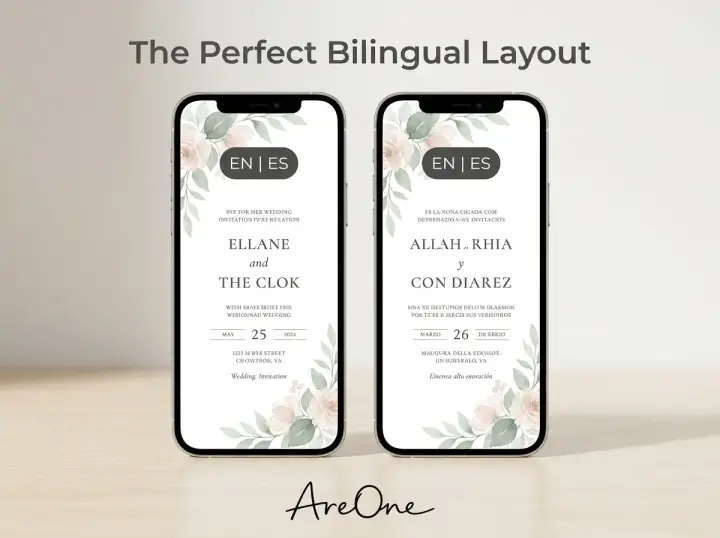
When structuring your bilingual wedding website or digital invitation, you generally have three primary layout options to consider. The side-by-side layout splits the screen vertically. English occupies one column, while German occupies the parallel column right next to it.
This aesthetic works beautifully on wider desktop screens but can feel extremely cramped on mobile devices. The stacked layout presents the complete English text block first, followed immediately by the entire German text block. This method solves the mobile screen space issue completely. However, the group reading the second language must scroll further down to find their relevant information.
For modern digital platforms, the language toggle reigns supreme. By adding a simple toggle button at the top of your platform, guests choose their preferred viewing mode instantly. The interface dynamically updates to display only the requested language. This approach delivers the cleanest visual experience possible, mimicking premium software applications.
Translation Checklist: Names, Honorifics, Dates, and Addresses
Accurate localization goes far beyond pasting your sentences into a free online translator. Cultural nuances dictate exactly how dates, times, and formal titles must be presented. A robust translation checklist prevents embarrassing formatting errors that could misdirect your guests.
Pay extremely close attention to these vital details before finalizing your copy:
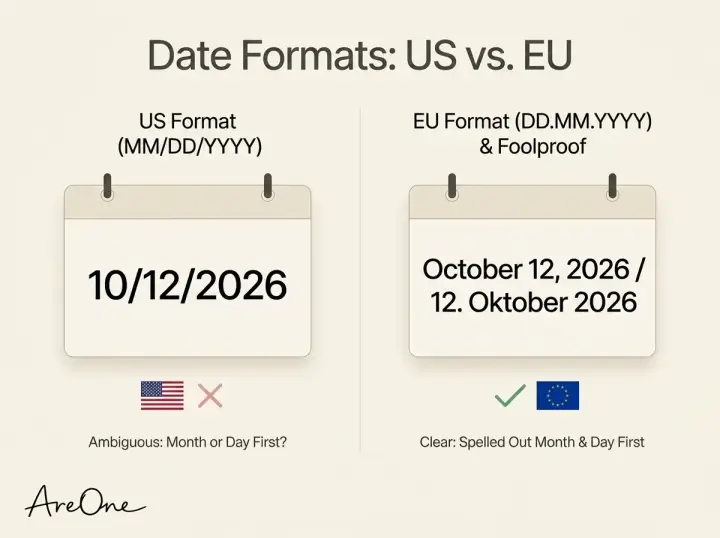
- Dates and Days: Americans use MM/DD/YYYY, whereas Germans strictly use DD.MM.YYYY. To prevent catastrophic scheduling misunderstandings, write out the month entirely. Use 'October 12, 2026' and '12. Oktober 2026' to guarantee absolute clarity.
- Time Formats: English speakers rely heavily on the 12-hour clock with AM and PM markers. German speakers utilize the 24-hour clock natively. Translate '3:00 PM' to '15:00 Uhr' so no one arrives at the wrong time.
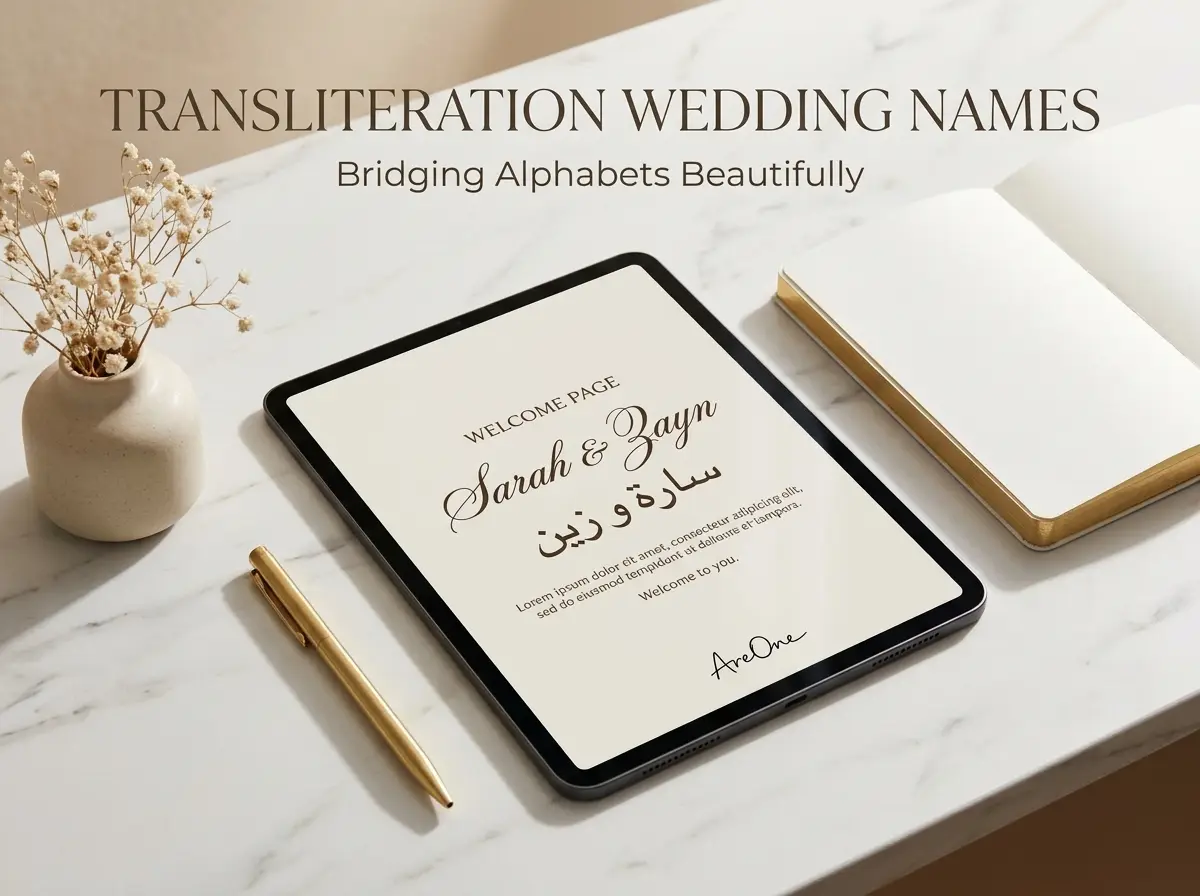
- Honorifics and Titles: English relies on 'Mr.', 'Mrs.', or 'Ms.' In German, you will use 'Herr' and 'Frau'. Ensure you do not accidentally translate a person's actual first or last name in the process.
- Location Details: Decide whether to translate the venue name or keep the local phrasing intact. Usually, proper nouns like 'Schloss Neuschwanstein' should remain untouched to help guests navigate accurately with their GPS devices.
- Dress Code Etiquette: 'Black Tie Optional' does not have a direct, perfect German equivalent. You might need to use descriptive phrasing like 'Festliche Abendgarderobe' to convey the exact level of formality expected from your attendees.
Always have a native speaker review your final draft. What sounds perfectly romantic in English might sound stiff or unintentionally comical in German. If you are configuring your digital response collection, ensure the forms match the requested language exactly. You can easily set this up via our advanced RSVP tracking tools.
Bilingual English German Wedding Invite Wording You Can Copy and Paste
Finding the exact phrasing that balances romance, clarity, and formality can take hours of tedious drafting. To save you precious time, we have curated multiple copy-paste examples for your upcoming celebration.
You can adapt these foundational templates to suit the specific vibe of your event perfectly. Notice how the German translations do not attempt to mirror the English sentence structure word-for-word. Instead, they capture the emotional essence while adhering to native phrasing conventions.
Recommended ReadingBilingual Invite Etiquette: Order, Typography, Names →Formal and Traditional Formats
Traditional weddings require a respectful, elegant tone throughout the correspondence. This wording works well for classic church ceremonies followed by a grand hotel reception. The phrasing honors parents and uses classic, timeless vocabulary.
English Wording Example:
Together with their families,
Eleanor Smith & Lukas Weber
request the honor of your presence
at their wedding celebration.
Saturday, the fourteenth of August, two thousand twenty-six
at three o'clock in the afternoon.
The Grand Estate, London.
Reception and dancing to follow.
German Wording Example:
Gemeinsam mit ihren Familien
laden Eleanor Smith & Lukas Weber
herzlich zu ihrer Hochzeit ein.
Samstag, 14. August 2026
um 15:00 Uhr.
The Grand Estate, London.
Im Anschluss bitten wir zum festlichen Empfang und Tanz.
Casual and Modern Alternatives
If you are planning an intimate backyard gathering, a casual beach ceremony, or a modern loft party, your language should reflect that relaxed atmosphere. These examples discard heavy formalities in favor of joyous, energetic excitement.
English Wording Example:
We are tying the knot!
Join Eleanor & Lukas for an evening of love, laughter, and great food.
August 14, 2026, at 3:00 PM.
The Grand Estate, London.
Bring your dancing shoes!
Browse invitation layouts that fit your plan.
Compare layouts for schedules, travel details, guest guidance, and RSVP information before choosing one for your invitation.



German Wording Example:
Wir trauen uns!
Feiert mit Eleanor & Lukas einen Abend voller Liebe, Lachen und gutem Essen.
14. August 2026, um 15:00 Uhr.
The Grand Estate, London.
Vergesst eure Tanzschuhe nicht!
5 Common Cultural Pitfalls to Avoid When Designing Your Invite
Even with the best intentions, couples frequently stumble into specific localization traps when drafting their announcements. Building a welcoming multicultural environment means actively navigating past these hidden linguistic obstacles.
A single mistranslated word can alter the entire mood of your beautifully designed announcement. Let us thoroughly examine the most frequent mistakes couples make during the drafting process, so you can bypass them and stress less.
Mistake 1: Relying Exclusively on Auto-Translate
Machine translation tools are fantastic for rapid comprehension, but they fail miserably at capturing romance, poetry, and idiomatic expressions. If you run a beautiful English poem through an automated system, the output in German will likely sound robotic, disjointed, or nonsensical.
Always hire a professional translator or enlist a trusted, bilingual family member. They can adapt the emotional nuances of your text so it reads naturally and beautifully in both target languages.
Mistake 2: Ignoring Compound Word Lengths
The German language is globally famous for its massive, imposing compound words. While English uses multiple short words to describe a concept, German fuses them into a single, unbreakable string of letters.
If your digital layout features narrow columns or rigid text boxes, these long German words will overflow the boundaries or force awkward, unreadable hyphenation. Always design with flexible grids that accommodate text expansion naturally without breaking the visual aesthetic.
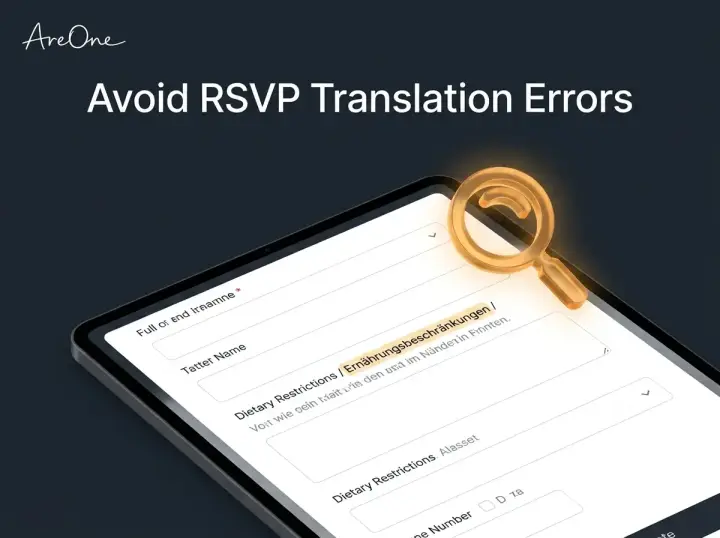
Mistake 3: Mishandling Dietary Restrictions
Food culture varies significantly across borders and oceans. When asking guests to submit their dietary requirements, ensure the terminology is crystal clear. A 'vegan' meal in one culture might just mean 'no red meat' in another traditional setting.
Need a faster RSVP flow?
Use AreOne to collect guest replies, meal choices, and reminders in one clean workflow.
Provide specific checkboxes or clear examples when requesting this vital information. Being precise protects your guests and helps your catering team deliver flawless service. To see how elegant this can look on a digital form, explore our premium invitation templates.
Mistake 4: Overcomplicating the Gift Registry
In many English-speaking countries, providing a direct link to a curated retail gift registry is completely standard practice. However, in Germany, wishing for cash gifts to fund a honeymoon or a household is common.
Germans often request this via a short, rhyming poem called a 'Spruch'. If you merge these traditions, explain your preferences gently and clearly. You can cite external etiquette guides from authoritative sources like The Knot or Brides to help family members understand unfamiliar foreign customs.
Mistake 5: Neglecting the Emotional Tone of Voice
A direct translation often strips away the core warmth of your original message. English frequently employs enthusiastic, emotional adjectives that might feel slightly exaggerated when directly converted into German phrasing.
Conversely, traditional German phrasing might sound overly rigid or clinical to an American ear. You must actively balance these cultural expectations. Ask your proofreader not just if the grammar is correct, but if the emotional temperature feels appropriate for a joyous celebration.
Feature Comparison: Managing Dual Languages Effectively
To help you decide exactly how to deliver your crucial event details, we have compiled a detailed comparison of the most popular digital and physical delivery methods.
Reviewing these strategies side-by-side clarifies which technical approach matches your personal design preferences, budget, and the overall technical literacy of your specific guest list.
| Delivery Strategy | Best Suited For | Major Advantages | Potential Drawbacks |
|---|---|---|---|
| Dynamic Language Toggle | Modern digital platforms and highly tech-savvy crowds. | Provides the cleanest visual aesthetic; requires zero tedious scrolling. | Requires a digital medium; completely impossible to replicate on printed paper. |
| Side-by-Side Columns | Printed physical cards with wide landscape orientations. | Allows simultaneous reading and immediate cross-language comparison. | Highly cramped and difficult to read on vertical mobile smartphone screens. |
| Stacked Text Blocks | Long-form storytelling and detailed weekend itineraries. | Maintains standard reading width and excellent overall legibility. | Forces the secondary language group to scroll constantly to find details. |
| Separate Invitations | Highly traditional events with strictly segregated guest cohorts. | Delivers a 100% native reading experience for every single guest. | Doubles the design effort, tracking complexity, and potential printing costs. |
As you can clearly see, leveraging premium software provides the most elegant, simpler solution for your guests. For comprehensive details on our subscription tiers that support dynamic language toggles effortlessly, please visit our pricing page.
Translating Your Love Into the Perfect Celebration
Crafting the perfect announcement speaks volumes about your dedication to unity and radical hospitality. By carefully curating the typography, double-checking your formatting, and choosing wording that resonates across borders, you orchestrate an experience where every single guest feels cherished.
When you finally distribute your bilingual English German wedding invite, you are quite literally translating your love into a universal language that transcends all borders. When you prioritize clear, culturally respectful communication, the logistical stress fades away entirely, leaving only joyous anticipation in its wake.
Ready to start building your simpler guest experience? Create your digital invite at AreOne.org today and experience our auto-language features firsthand.
Looking for visual inspiration before you begin? Browse our modern templates to find the perfect multicultural aesthetic for your big day.
Frequently Asked Questions
Find quick answers to common questions about this article.
No approved comments yet.