
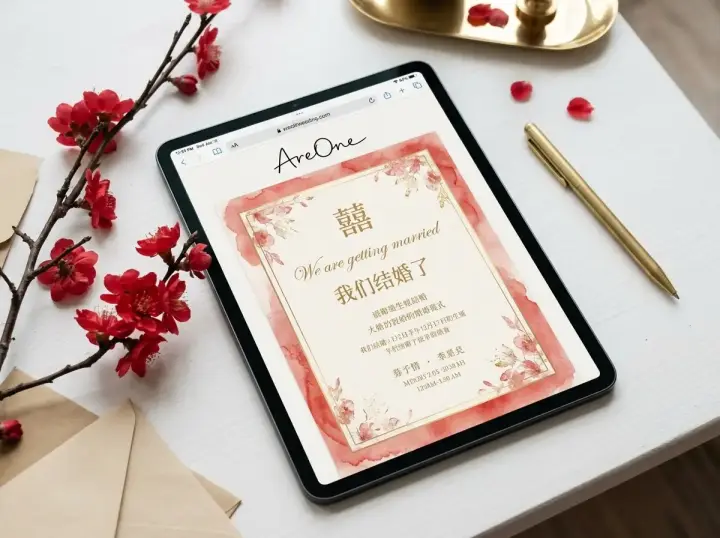
TL;DR: Crafting the perfect Chinese English wedding invitation wording ensures every guest, from your tech-savvy friends to your traditional grandparents, feels equally honored and informed.
Merging Cultures Through Your Digital Announcements
Planning a wedding that beautifully merges two rich cultures is an incredible milestone. However, ensuring both sides of the family are equally respected starts long before the ceremony begins. It initiates the very moment your guests receive their digital invitations on their phones or tablets.
If you are navigating the intricate balance of two diverse languages, you already know that literal translations rarely capture the true essence of your joy. Finding the ideal Chinese English wedding invitation wording is about far more than just swapping vocabulary words. It requires a delicate understanding of tone, traditional family hierarchy, and visual harmony.
You want to honor ancient customs without losing the modern, clean aesthetic that represents you as a couple. Whether you are hosting an extravagant formal banquet or an intimate garden ceremony, the way you invite your loved ones sets the absolute stage.
Who Needs Multilingual Invites (Common Scenarios)
Merging two lives often means merging two distinct family trees, and frequently, two different linguistic backgrounds. You might wonder if you need a dual-language approach for your big day. The short answer is yes, especially if your guest list spans multiple continents or generations.
Consider a common scenario where the bride's extended family resides in Taiwan or Hong Kong, speaking predominantly Mandarin or Cantonese. Meanwhile, the groom's family is firmly rooted in the United States or the United Kingdom. Sending an English-only invite might easily isolate the overseas guests.
Conversely, a Chinese-only version would leave the Western side completely confused about the venue location and the daily timeline. A thoughtfully designed multicultural wedding invite becomes the perfect communication bridge. It beautifully accommodates everyone without making any single group feel like an afterthought.
This dual approach is also beneficial for first-generation couples whose parents speak Chinese comfortably at home, but whose friends communicate in English. By offering both languages natively, you completely eliminate the need for frantic text messages clarifying the start time or the exact dress code.
UX Rules: Layout, Order, Typography, Clarity
When designing a sophisticated bilingual wedding website, user experience (UX) is your absolute secret weapon. Combining the Latin alphabet with complex, dense Chinese characters poses a very unique visual challenge. If not handled carefully, your beautiful digital invite can quickly look cluttered.
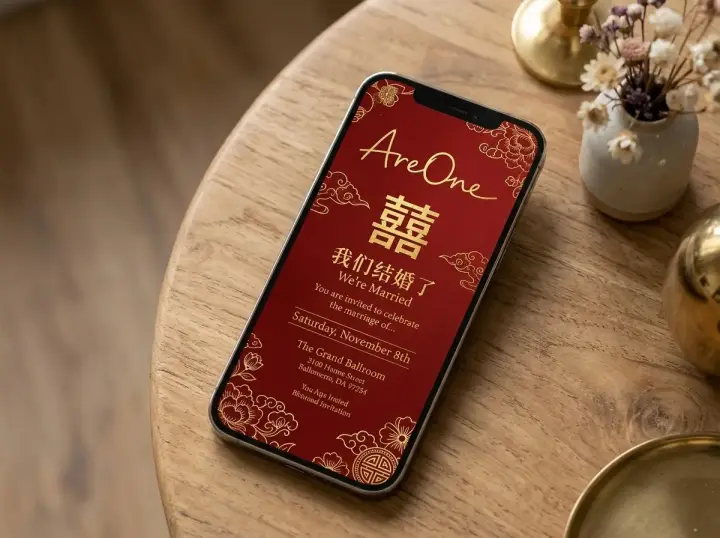
The first unbreakable rule of typography in this context is pairing fonts that carry a visually similar weight. A delicate, sweeping English calligraphy script might clash jarringly with a bold, rigid Chinese block font. You want your typography to look like it belongs to the exact same design family.
Instead of mixing drastic styles, look for a clean serif or sans-serif combination. Keep the stroke thickness consistent to maintain an elegant, unified appearance across all devices. Clarity heavily depends on utilizing negative space effectively. Give your text plenty of room to breathe naturally.
Do not cram both languages into a tiny text box on the screen. Use ample line spacing, especially since Chinese characters are generally much denser and require more vertical room to remain legible on small mobile screens. For inspiration, explore our beautiful modern templates designed specifically for clear typography.

Side-by-side vs Stacked vs Language Toggle
You essentially have three primary layout choices when displaying two languages, each serving a fundamentally different purpose. The stacked approach places the English text first, immediately followed by the Chinese translation directly underneath. This is a traditional method.
Stacked text works reasonably well for very short, formal invitations where you want both languages visible at a single glance. However, on modern mobile devices, this can require an annoying amount of scrolling for the user. The side-by-side layout splits the screen into two vertical columns.
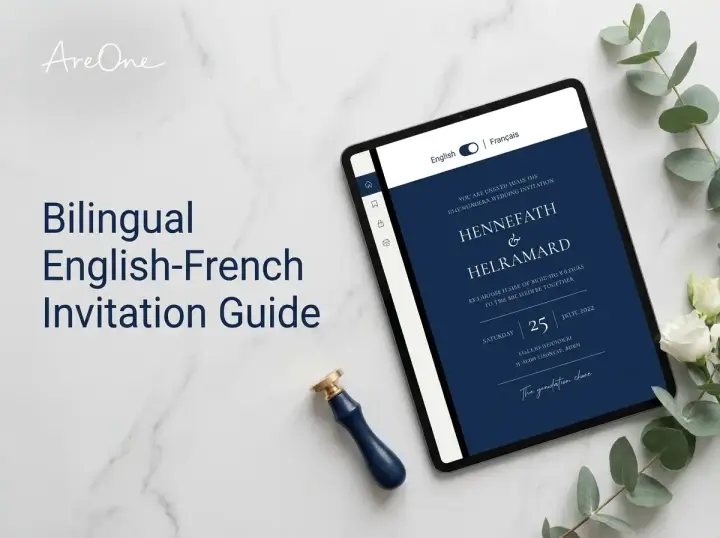
While the column layout looks sophisticated on wide desktop monitors, it frequently breaks or stacks awkwardly on smartphones. The most modern, elegant, and user-friendly solution is the dynamic language toggle. A smart digital platform allows guests to select their preferred language via a simple, intuitive button.
This ensures the entire design remains minimalist and is tailored to the reader's native tongue. Check out how you can implement seamless experiences using advanced multilingual digital features to delight your guests instantly.
Essential Translation Checklist for Your Invites
Translating an important announcement is rarely a straightforward task. Cultural nuances heavily dictate that what sounds perfectly polite in one language might sound terribly abrupt or confusing in another. To prevent critical details from getting lost, you must follow a rigorous translation checklist.
- Names and Hierarchy: In traditional Chinese etiquette, the parents are often positioned as the official hosts of the event. Ensure their names are translated correctly, maintaining the proper family name order.
- Generational Honorifics: Chinese culture places high importance on deep generational respect. Make sure terms referring to elders, grandparents, or specific family roles are culturally accurate.
- Dates and Calendars: Always include the traditional Lunar calendar date alongside the standard Gregorian date to satisfy older relatives.
- Venue Clarity: Never translate a western venue name literally. Provide the official phonetic translation alongside the exact physical address in the native language to assist with accurate GPS navigation.
- Dietary Requests: Ensure your RSVP section explicitly asks about allergies in both languages to avoid any banquet day surprises.
Double-checking these specific elements guarantees that your communication is as respectful as it is beautiful. A thorough translation checklist prevents minor oversights from becoming major familial misunderstandings on your special day.
Recommended ReadingEnglish–French Invitation Wording Examples & Design Guide →Crucial Translation Checklist Table
To make your rigorous planning process as smooth as possible, we have compiled a quick, easy-to-read reference guide. Use this comparative table alongside your translation checklist to ensure you never miss a vital cultural detail.
| Invitation Element | Standard English Format | Traditional Chinese Format Requirements |
|---|---|---|
| Hosting Names | "Together with their families" | Strict hierarchy: Parents' names must be listed clearly by seniority. |
| Date & Time | Saturday, October 14th, 2026 | Must explicitly include the Gregorian date AND the traditional Lunar date. |
| Location Info | The Grand Hotel, 123 Main St. | Official phonetic translation, plus highly localized transit directions if applicable. |
| RSVP Details | Please reply by September 1st | Clear, respectful request for attendance confirmation, noting exact dietary needs. |
Keep this table handy when you sit down to draft your initial wording. It serves as a fantastic baseline for keeping both sides of your family perfectly aligned and informed.
Copy-Paste Examples of Chinese English Wedding Invitation Wording
Crafting the exact phrasing from scratch can be intimidating for any couple. To help you get a massive head start, here are prepared copy-paste examples of Chinese English wedding invitation wording that you can easily adapt for your own digital invites.
Formal and Traditional Example:
In this formal scenario, the parents are officially hosting the magnificent event. This is respectful and common in traditional multicultural families.
English: "Mr. and Mrs. Chen, together with Mr. and Mrs. Smith, request the honor of your presence at the marriage of their children, Wei and Emily. Saturday, the eighth of August, two thousand and twenty-six."
Chinese: "陳大文夫婦 與 史密斯夫婦 敬邀 您出席 愛女 蔚 與 愛子 艾米麗 的結婚典禮。 公曆 2026 年 8 月 8 日 (農曆丙午年七月十五日)."
This traditional phrasing beautifully honors the parents while clearly communicating the immense joy of the upcoming union to all older relatives.
Modern and Casual Example:
If you are hosting the wedding yourselves and prefer a much more relaxed, contemporary vibe, keep the wording light and direct.
English: "We’re tying the knot! Emily and Wei warmly invite you to celebrate their wedding day with fantastic food, cold drinks, and endless dancing."
Chinese: "我們要結婚了! 艾米麗 與 蔚 誠摯邀請您來參加我們的婚禮,一起分享美食、美酒與歡樂."
This specific approach strips away the heavy, rigid formality, making it perfect for a modern bilingual wedding website tailored to younger friends and colleagues.
Browse invitation layouts that fit your plan.
Compare layouts for schedules, travel details, guest guidance, and RSVP information before choosing one for your invitation.



Common Cultural Pitfalls to Avoid
Even with the absolute best intentions, busy couples frequently fall into unexpected cultural traps when drafting their bilingual announcements. Let us review the absolute most common mistakes so you can completely bypass them.
Mistake 1: Relying Exclusively on Machine Translation
Using a automated tool like Google Translate is risky for formal, high-stakes announcements. Machine translation often fails completely to grasp idiomatic expressions, nuanced cultural context, or the formal tone required for a wedding. Always have a native speaker rigorously review your final text.
For fantastic external guidance on cultural etiquette, reputable sources like The Knot strongly recommend utilizing professional translators or trusted family proofreading. Do not leave your vital first impression up to a simple algorithm.
Mistake 2: Forgetting the Lunar Calendar
For many older traditional Chinese relatives, the lunar calendar directly dictates the auspiciousness and luck of the chosen wedding date. Providing only the Western Gregorian calendar date can cause immediate confusion or perceived disrespect. A thoughtfully crafted multicultural wedding invite will proudly and clearly display both dates.
Mistake 3: Mishandling the Color Palette
In standard Western cultures, stark black and white heavily signify black-tie elegance and modern minimalism. However, in traditional Chinese culture, black and white are heavily associated with solemn mourning and funerals. When designing your invite, ensure you incorporate auspicious colors like vibrant red or gold.
Mistake 4: Disregarding Family Hierarchy
Western invites often casually list the couple's names first, emphasizing independence. In a traditional Chinese household, ignoring the parents' names or placing them beneath the couple can easily be seen as a severe sign of disrespect. Always explicitly confirm the preferred naming order with both sets of parents.
Designing for Elders: Keeping Invites Accessible
When dealing with complex bilingual formats, we often focus so heavily on the exact language that we forget about the actual physical readers. Many of the VIP guests relying on the translated text will be older relatives, such as grandparents. Accessibility is paramount here.
Need a faster RSVP flow?
Use AreOne to collect guest replies, meal choices, and reminders in one clean workflow.
Avoid using ultra-thin, light grey typography on stark white backgrounds. The visual contrast needs to be sharp for older, tired eyes to read comfortably without straining. When choosing your overall font sizes, always err on the side of larger text.
This is especially critical for dense, complex Chinese characters that can easily blur together at very small pixel scales. you must make the digital RSVP process straightforward. A high-tech digital platform is fantastic, but the interaction buttons must be massive and visible.
If you are pointing guests directly to your smart RSVP tracking system, ensure the "Accept" and "Decline" options are flawlessly translated and easy to tap on a small mobile device. You certainly do not want your grandmother struggling to figure out how to tell you she is coming.
Digital vs. Paper: Why Bilingual Websites Win
The endless debate between sending physical paper and modern digital invites is very easily settled when you introduce multiple dense languages into the mix. Traditional paper invitations have extremely strict fixed dimensions. You simply run out of room very fast.
If you try to print both full English and full Chinese paragraphs on a standard five-by-seven paper card, you are forcefully required to shrink the font size dramatically. This immediately sacrifices both the high-end aesthetics and the basic readability for your older guests.
Going completely digital eliminates these frustrating physical constraints. A dedicated bilingual wedding website offers virtually infinite space. You can utilize a sleek language toggle, completely separating the languages so the design remains pristine and uncrowded at all times.
advanced digital platforms allow for instant, simpler updates. If the banquet venue unexpectedly changes or a timing adjustment occurs, you do not have to reprint and mail hundreds of expensive bilingual cards. This incredible flexibility makes our premium digital packages the overwhelmingly superior choice.

Speaking the Universal Language of Love
When it comes to merging families gracefully, finding the perfect Chinese English wedding invitation wording isn't just about speaking two different languages perfectly—it's about speaking the universal language of love and deep mutual respect. By honoring both cultures flawlessly, you guarantee a beautiful start to your new life together.
Frequently Asked Questions
Find quick answers to common questions about this article.
No approved comments yet.