
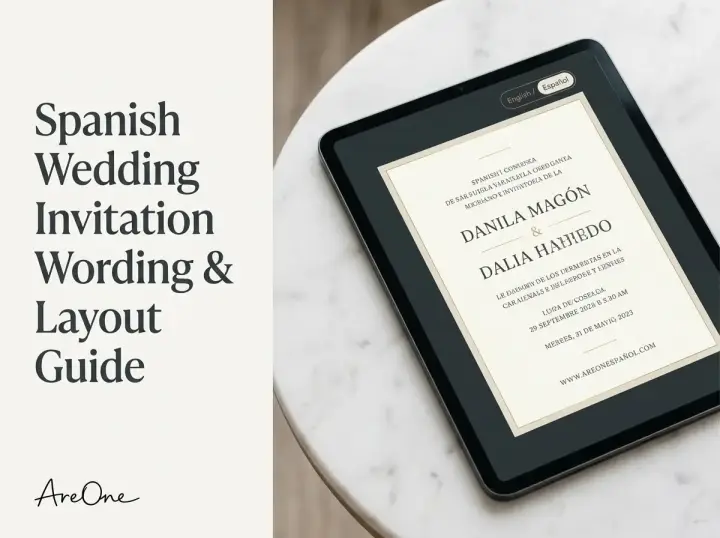
TL;DR: Perfecting your Spanish wedding invitation wording requires careful attention to cultural etiquette, clear layout design, and accurate translations to ensure every guest feels welcomed.
Mastering Your Bilingual Invites
Welcoming guests to your celebration starts long before they arrive at the venue. When you are planning an international or multicultural event, nailing your Spanish wedding invitation wording is an absolute priority. We know it feels tricky to balance two languages without overcrowding the design. You want your aunts from Madrid and your college friends from New York to feel equally cherished.
Creating a seamless experience requires a mix of good design, cultural awareness, and clear communication. A modern digital approach makes this much easier. While physical cards offer limited space, digital solutions allow you to expand your message. We are here to guide you through the exact phrasing, addressing rules, and design choices you need to make.
Whether you are hosting a destination event in Mexico or blending two families in your hometown, getting the text right matters. From formal parent-hosted templates to casual, modern phrasing, you will find exactly what you need.
Who Needs a Multicultural Wedding Invite?
Deciding to use two languages on your stationery is a thoughtful choice. A multicultural wedding invite is essential whenever a significant portion of your guest list speaks a different primary language. This is not just about translation; it is about hospitality. When guests receive a beautifully crafted message in their native tongue, they instantly feel valued and respected.
Common scenarios include blending a Spanish-speaking family with an English-speaking family. Even if some relatives speak conversational English, formal event details can easily be misunderstood. Providing clear information in both languages eliminates confusion regarding dates, dress codes, and venue locations.
Another frequent scenario is the destination wedding. If you are traveling to a beautiful Spanish-speaking country, incorporating the local language adds a lovely touch of cultural immersion. However, you must ensure your guests understand the travel logistics. This is where a comprehensive guide to bilingual invitations becomes your best planning tool.
UX Rules for Visual Harmony
User experience (UX) is not just for software; it applies directly to your stationery. When you add a second language, you double the amount of text. Without strict UX rules, your design will quickly become cluttered and overwhelming. The first rule is to establish a clear visual hierarchy. Guests should immediately know where to look for their preferred language.
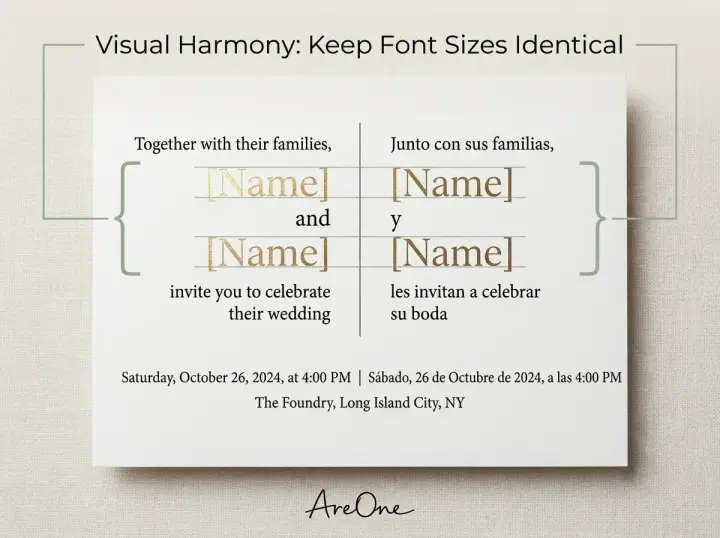
Typography plays a massive role in visual harmony. It is vital to use the exact same font size and weight for both English and Spanish. Shrinking the Spanish text just because it happens to run longer is a common design error that makes one language feel secondary. Instead, adjust your overall layout to accommodate the longest phrases gracefully.
Whitespace is your best friend when designing a bilingual wedding website or physical card. Give your text room to breathe. If you are struggling to fit everything onto a single printed card, it is time to leverage digital technology. You can keep the physical card minimalist and direct guests online for the full translated details.
Side-by-Side vs. Stacked vs. Language Toggle
When laying out your text, you generally have three layout options. Each has distinct advantages depending on your medium. Below, we compare these methods to help you choose the best fit for your aesthetic.
| Layout Style | How It Works | Best Used For | Pros & Cons |
|---|---|---|---|
| Side-by-Side | English on the left, Spanish on the right (or vice versa) divided by a line. | Wide or landscape printed cards. | Pros: Equal visual weight. Cons: Requires a wider format; can look dense. |
| Stacked | English paragraph followed immediately by the Spanish translation below it. | Standard portrait cards and simple emails. | Pros: Easy to read top-to-bottom. Cons: Makes the invite twice as long. |
| Language Toggle | A button that switches the entire page from English to Spanish automatically. | Your bilingual wedding website and digital invites. | Pros: The cleanest UX possible. Cons: Only available on digital platforms. |
For digital invites, the language toggle is universally recognized as the superior choice. You can learn more about perfecting your digital design by reviewing our multilingual website UX rules.
Recommended ReadingBilingual Wedding Invitations: How to Make Them Clear & Elegant →Your Essential Translation Checklist
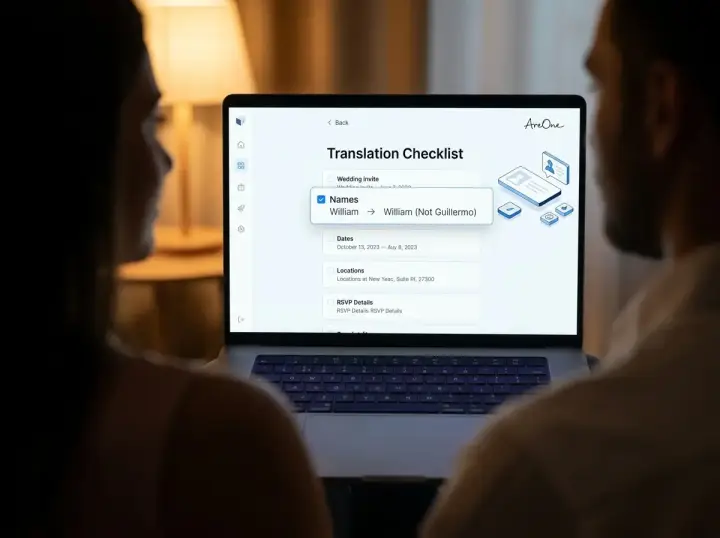
Translating an invite is never a simple word-for-word task. Cultural nuances heavily influence how information is presented. A thorough translation checklist prevents awkward phrasing and ensures all vital details remain accurate across both versions. Before you finalize any text, carefully review each of these elements.
[Insert Image Here: A happy couple reviewing their digital invite draft on a laptop]
- Names: Do not translate proper names. If your name is William, keep it as William, not Guillermo.
- Honorifics: Understand when to use formal titles like Don and Doña versus casual terms. These carry deep cultural respect.
- Dates: Be hyper-aware of date formatting. In English, we often use Month/Day/Year. In Spanish, it is Day/Month/Year. Spell out the month to avoid any confusion.
- Locations: Keep the actual street address in the language of the host country so taxi drivers and GPS systems can find it easily.
- Dress Code: Ensure the attire translation accurately reflects the formality. Black Tie translates differently depending on the region.
Running through this checklist guarantees your guests will arrive at the right place, on the right day, wearing the right attire.
Extensive Copy-Paste Examples
Browse invitation layouts that fit your plan.
Compare layouts for schedules, travel details, guest guidance, and RSVP information before choosing one for your invitation.



Finding the right tone is often the hardest part of drafting your invites. Spanish formal phrasing can differ significantly from English norms. To make your planning easier, we have provided several copy-paste examples. You can adapt these templates directly into your preferred designs.
Example 1: Traditional & Hosted by Parents
In many Hispanic cultures, it is customary for both sets of parents to invite the guests. The phrasing is respectful and formal.
English: Together with their families, [Name] and [Name] request the honor of your presence at their marriage...
Spanish: Con la bendición de Dios y de sus padres, [Parents' Names], tienen el honor de invitarles al enlace matrimonial de sus hijos [Name] y [Name]...
This wording works beautifully for traditional church ceremonies and formal receptions. It honors the families' role in the union.
Example 2: Modern & Hosted by the Couple
If you are paying for the event yourselves and prefer a relaxed vibe, you can drop the heavy formalities.
English: We invite you to share in our joy as we tie the knot!
Spanish: ¡Te invitamos a celebrar nuestra boda y compartir nuestra alegría!
This phrasing is direct, friendly, and perfect for modern celebrations. It speaks directly to your peers and close family members without feeling overly stiff.
Example 3: Destination Wedding Excitement
When asking guests to travel, inject some excitement into the wording while remaining clear about the location.
English: Pack your bags! We are getting married in beautiful Oaxaca.
Spanish: ¡Prepara tus maletas! Nos casamos en la hermosa ciudad de Oaxaca.
For destination events, always remember to link directly to your digital hub where guests can find travel and accommodation details. You can easily set this up using our modern wedding website templates.
Key Etiquette Rules for Addressing
Addressing your envelopes or digital delivery fields requires precision. Spanish addressing etiquette carries specific rules regarding family names and respect. For older relatives or formal guests, it is customary to use Señor (Sr.) and Señora (Sra.). When addressing a married couple, you might write Sr. y Sra. Garcia.
Need a faster RSVP flow?
Use AreOne to collect guest replies, meal choices, and reminders in one clean workflow.
A unique aspect of Spanish naming conventions is the use of two surnames (the father's first surname followed by the mother's first surname). When writing formal addresses, try to include both surnames if you know them. It shows a high level of respect and attention to detail.
For digital invitations, keeping the addressing accurate ensures the email or text message feels personal. Always double-check spellings and accents. Missing an accent mark can sometimes change the meaning of a word entirely, which is an easily avoidable mistake. For a deeper look into general wording etiquette, trusted sources like Brides offer excellent foundational rules.
4 Common Mistakes When Crafting Bilingual Invites
Even with the best intentions, couples frequently stumble into a few predictable traps. Understanding these common mistakes will save you time, money, and unnecessary stress. Let us walk through the most frequent errors and how to bypass them entirely.
Mistake 1: Blindly Trusting Automated Translators
Using Google Translate for your official stationery is a major risk. Automated tools often provide literal translations that sound robotic or miss the cultural nuance entirely. For instance, the phrase Save the Date does not translate literally to Salva la fecha. The correct cultural equivalent is Reserva la fecha. Always have a native speaker review your text before hitting publish or print.
Mistake 2: Forgetting the Date Format Differences
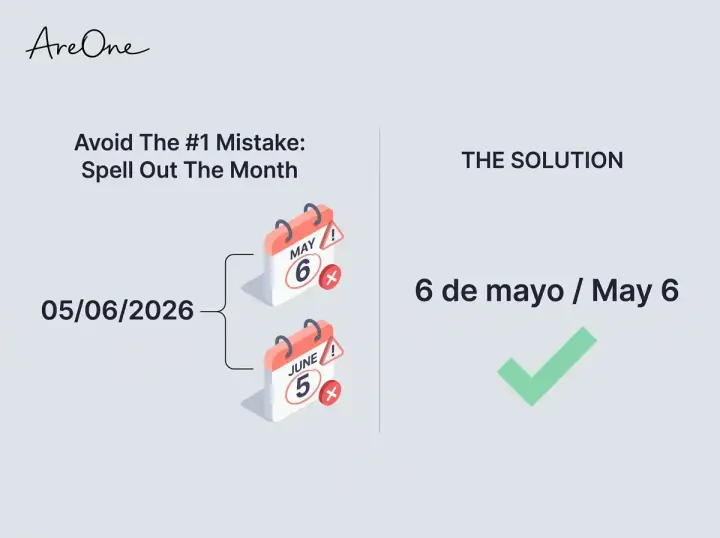
We mentioned this briefly in our checklist, but it deserves its own spotlight because it causes so much chaos. If you write 05/06/2026, your American guests will mark May 6th on their calendars. Your Spanish-speaking international guests will mark June 5th. This is a logistical nightmare. Always spell out the month. Write out May 6, 2026 or 6 de mayo de 2026 to guarantee everyone is on the same page.
Mistake 3: Overcrowding a Single Card
Couples often try to force English, Spanish, hotel blocks, registry links, and maps onto one 5x7 piece of paper. The result is unreadable, microscopic text. The solution is simple. Print the absolute bare minimum on the physical card (Names, Date, Location) and direct everyone to a digital platform for the rest. For guidance on managing these digital RSVP details effectively, you can consult experts at The Knot.
Mistake 4: Mixing Formal and Informal Tones
Spanish has distinct pronouns for formal (Usted) and informal (tú) address. A frequent mistake is starting the invitation with a formal tone and switching to an informal tone halfway through the details section. You must pick one lane and stay in it. If the event is black-tie, use Usted throughout. If it is a beach party, tú is perfectly acceptable.
A Flawless Delivery for Every Guest
Sending out your invitations is a thrilling milestone. By prioritizing clear layouts, accurate translations, and cultural respect, you set a joyous tone for the entire event. Your guests will appreciate the effort you made to communicate with them in their preferred language. It removes anxiety and replaces it with pure anticipation.
Remember to rely on digital tools to do the heavy lifting. Features like auto-language detection on websites can instantly serve the correct language to the correct guest without them having to click a single button. This level of modern convenience makes planning a joy rather than a chore.
A Perfect Translation for Your Big Day
Finding your ideal Spanish wedding invitation wording does not have to translate into a headache. With the right templates, a solid understanding of cultural etiquette, and a powerful digital platform, you can craft a message that speaks beautifully to everyone you love.
Ready to impress your international guests?
Frequently Asked Questions
Find quick answers to common questions about this article.
No approved comments yet.