
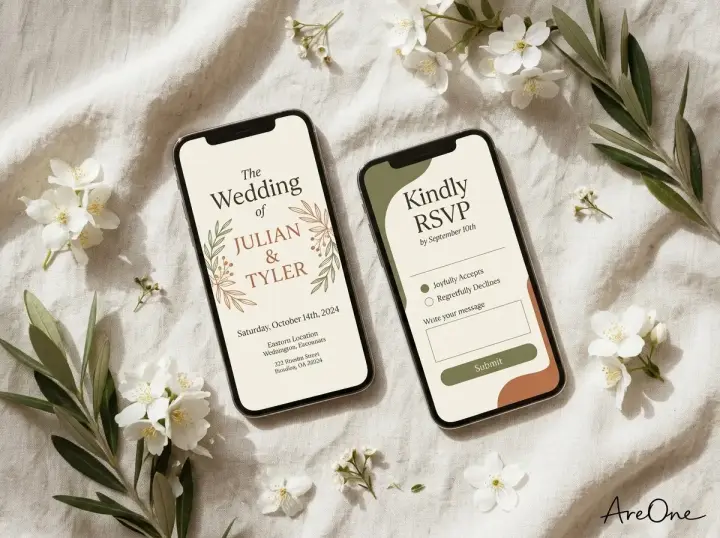
TL;DR: Discover beautiful, inclusive, and modern LGBTQ wedding invitation wording templates designed to celebrate your unique love story while guiding your guests with clarity.
Planning your big day means making countless exciting decisions. From selecting the perfect venue to tasting cakes, every choice reflects who you are as a couple. However, getting your LGBTQ wedding invitation wording exactly right is a massive milestone that deserves your full attention.
Your invitation sets the stage. It is the very first glimpse your guests will get into the beautiful celebration you are planning. For many same-sex and queer couples, traditional templates can feel slightly restrictive, outdated, or misaligned with modern relationships.
You deserve wording that honors your partnership. You need phrases that feel warm, clear, and completely authentic to your unique dynamic. Fortunately, rewriting the rules is in your hands.
Whether you are throwing an elegant black-tie gala or a relaxed backyard bash, we have gathered everything you need.
When to Use This Specific Wording (Context and Etiquette)
Understanding exactly when and how to deploy specific phrasing is crucial for a smooth planning process. Modern celebrations are delightfully diverse, meaning you have the freedom to craft an experience that feels right to you.
However, clarity must always remain your top priority. Your guests, especially older relatives or those traveling from afar, rely on the invitation to understand the exact nature of the event.
The context of your wedding dictates the language you choose. If you are hosting a formal affair at a grand hotel, your wording should elevate the guest's expectations. Conversely, a beachside ceremony calls for relaxed, breezy phrasing.
Proper wedding invitation etiquette still matters, even when you are breaking traditional molds. Etiquette is simply a tool for making people feel comfortable, welcome, and informed.
Timing your invitations correctly is another essential aspect. If you are curious about the exact timelines for sending out your beautifully worded invites, check out our comprehensive wedding invitation timeline to ensure no guest is left scrambling to book flights.
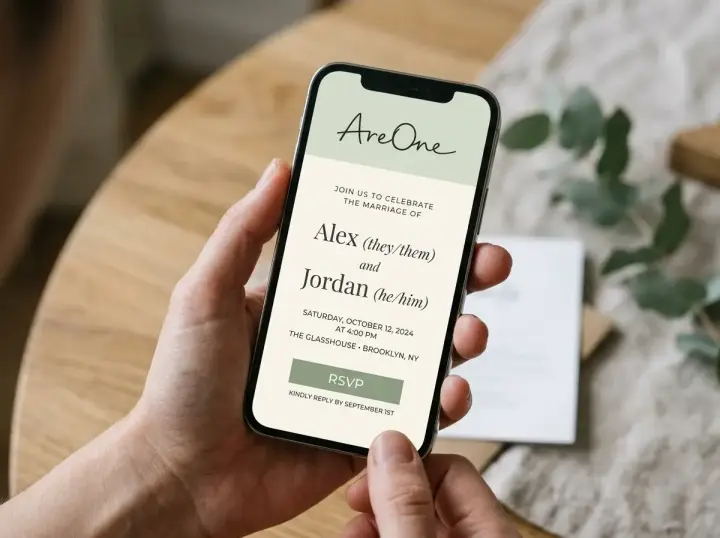
Quick Rules for Perfect Etiquette (Tone, Clarity, and Sensitivity)
Before you start typing out your final draft, it is helpful to establish a few core guidelines. Writing your invitations does not have to be stressful when you follow a clear set of principles.
First, always establish the tone early. The vocabulary you use directly communicates the vibe of the wedding. Words like "request the honor of your presence" immediately signal a formal event, whereas "join us for drinks and dancing" signals a casual party.
Second, prioritize absolute clarity. Creativity is wonderful, but never at the expense of necessary information. Guests must easily find the date, time, location, and dress code without needing to guess.
Cultural sensitivity and family dynamics play a huge role here. Many queer couples navigate complex family structures. Choose wording that respectfully acknowledges those who are supporting you, without feeling forced into heteronormative or patriarchal traditions.
To ensure you never miss a beat, follow this simple checklist for flawless execution:
- Names first: Clearly state who is getting married. Alphabetical order or simply what sounds best is perfectly fine.
- The Host Line: Clearly identify who is throwing the party (the couple, parents, or everyone together).
- The Request: Explicitly ask the guest to attend the ceremony, reception, or both.
- The Details: Provide the exact date, time, and venue address with zero ambiguity.
- The Next Step: Provide a clear RSVP deadline and method.
For a deep dive into traditional standards, you can always reference authoritative sources like The Emily Post Institute, which offers great foundational advice that you can easily modernize for your own needs.
Host Lines: Navigating Who is Inviting Who
The host line is often the trickiest part of the invitation. Historically, the bride's parents paid for the wedding and therefore "hosted" the event. Today, this tradition is rapidly evolving.
Many LGBTQ+ couples finance their own weddings entirely. In this scenario, you are the exclusive hosts. This makes the wording wonderfully straightforward and empowering.
Alternatively, both sets of parents might be contributing financially or emotionally, and you wish to honor them equally. In these cases, a joint hosting line is the most diplomatic and loving approach.
Sometimes, family situations are sensitive. If certain family members are not supportive, you do not have to include them on your invitation. Your wedding day is about celebrating your love surrounded by genuine support.
Using inclusive language like "Together with their families" is a brilliant, catch-all solution. It honors everyone who has nurtured your relationship without getting bogged down in specific names or complex financial arrangements.
Copy-Paste LGBTQ Wedding Invitation Wording Examples
Staring at a blank screen is the hardest part of the design process. To make your life infinitely easier, we have compiled a robust selection of wedding invite examples for you to use as inspiration.
You can mix, match, and modify any of these templates. The goal is to find the exact combination of words that makes your heart sing and accurately reflects your upcoming celebration.

Short Versions (Mobile-Friendly and Direct)
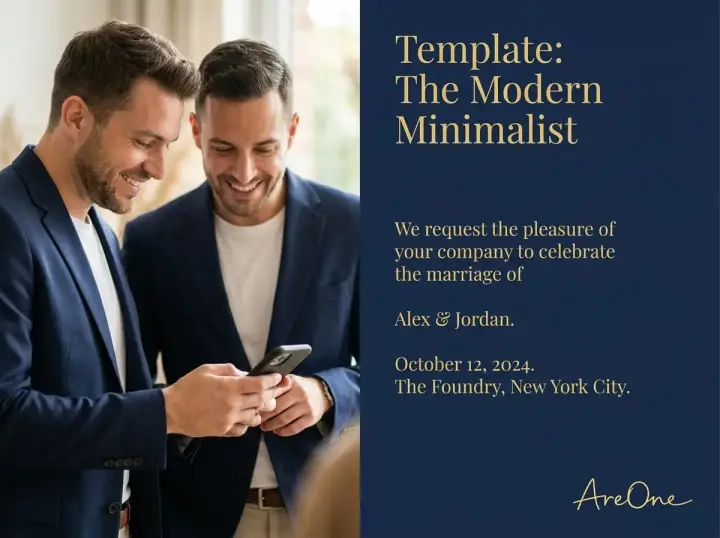
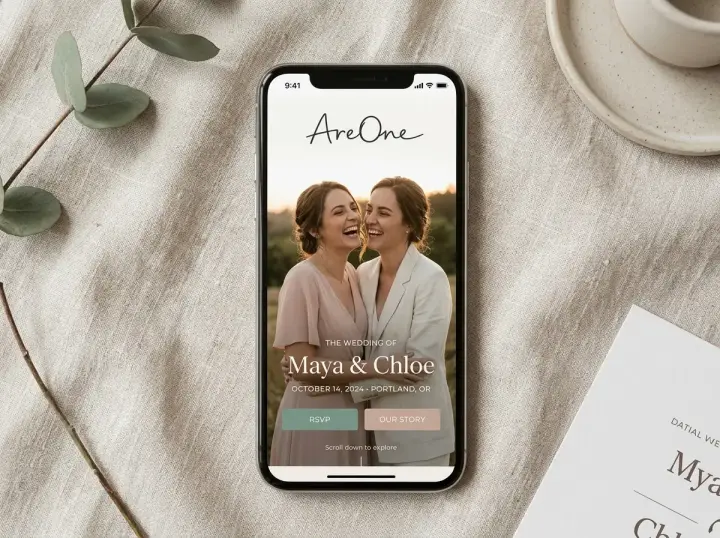
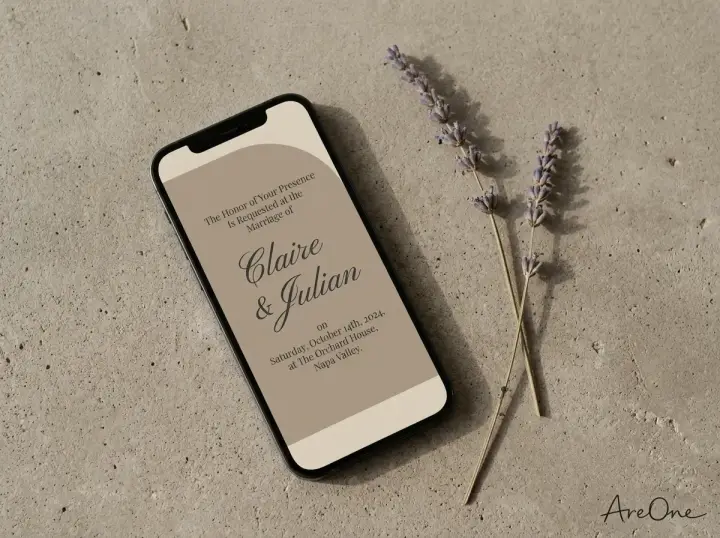
In our fast-paced era, many couples opt for digital invitations viewed primarily on smartphones. Because screen real estate is limited, short and punchy wording is effective.
These mobile-friendly options cut straight to the point while retaining plenty of warmth and charm. They are perfect for modern, streamlined couples who want to prioritize ease of reading.
Example 1: The Modern Minimalist
"Alex and Jordan are getting married! Join us as we celebrate our love and tie the knot. Saturday, October 14th at 4:00 PM. The Greenhouse, Downtown. Drinks, dinner, and heavy dancing to follow."
Why this works: It is punchy, energetic, and gives the guest every single piece of required information in just a few lines. It is ideal for texting or quick digital sends.
Example 2: The Casual Celebration
"We’re making it official! Please join Sarah and Maya for an intimate wedding ceremony and a massive party afterwards. November 2nd, 5:00 PM at The Harbor Club. Bring your dancing shoes."
Why this works: It establishes a fun, relaxed tone immediately. The mention of "dancing shoes" is a subtle hint about the lively nature of the reception.
Example 3: Together With Families
"Together with their loving families, David and Mateo invite you to share in their joy as they exchange vows. Friday, June 10th at sunset. Oceanview Pavilion."
Recommended ReadingMicro Wedding Invitation Wording: Modern Examples & Etiquette →Why this works: It is slightly more structured but remains brief. It beautifully acknowledges family support without requiring lengthy lists of parents' names.
To see how these short versions look in action, feel free to browse our stunning collection of digital invitation templates designed specifically for clear, mobile-friendly viewing.
Browse invitation layouts that fit your plan.
Compare layouts for schedules, travel details, guest guidance, and RSVP information before choosing one for your invitation.



Longer Versions (Traditional and Elaborate)
If you are hosting a grand affair, or if you simply adore the romance of traditional language, longer wording is the way to go. These versions are elegant, sophisticated, and romantic.
Balancing formal vs casual wording is an art form. Formal wording requires spelling out numbers, times, and dates, and usually relies on third-person phrasing. Let us look at a few elevated examples.
Example 4: The Formal Event
"Mr. and Mrs. Robert Chen, alongside Mr. and Mrs. Thomas Wright, request the honor of your presence at the marriage of their sons, Julian Chen and Leo Wright. Saturday, the ninth of September, two thousand and twenty-six, at six o'clock in the evening. The Grand Plaza Hotel. Black tie reception to immediately follow."
Why this works: It perfectly mirrors classic high-society invitations. Every detail is spelled out, explicitly setting a luxurious, black-tie expectation for the guests.
Example 5: The Romantic Epic
"Because you have shared in our lives by your friendship and love, we, Elena Rodriguez and Chloe Smith, joyfully invite you to witness the beginning of our new life together. Please join us for a weekend of celebration, beginning with our marriage ceremony on Saturday, August twelfth at four o'clock. The Botanical Gardens."
Why this works: This language centers on community and shared love. It is emotional, formal, but wonderfully welcoming to guests who have supported the couple's journey.
Example 6: The Independent Formal
"With joyful hearts, Marcus Thorne and Samuel Vance request the pleasure of your company as they unite in marriage. Please join us in celebrating a lifetime of love and adventure. The fifteenth of May at five o'clock. The Historic Manor."
Why this works: It maintains a formal tone but clearly establishes that the couple is hosting the event themselves. It is confident, elegant, and perfectly balanced.
For more inspiration on formal trends, respected bridal publications like Brides magazine frequently showcase stunning examples of elevated, modern phrasing.
4 Common Mistakes and Much Better Alternatives
Even the most meticulously planned weddings can suffer from slight invitation blunders. Knowing what pitfalls to avoid will save you time, money, and endless questions from confused guests.
Here is a deep dive into the four most common mistakes couples make with their wording, and exactly how to fix them gracefully.
Mistake 1: Relying Exclusively on Heteronormative Templates
Many standard templates default to "Bride and Groom" or list the bride's name first simply out of habit. Using these without thinking can feel inauthentic to a queer couple.
The Better Alternative: Throw the rigid rules out the window. List your names alphabetically, or simply say them out loud to see which rhythm sounds better. Use terms like "to be married," "to wed," or "to join in partnership" that feel uniquely yours.
Need a faster RSVP flow?
Use AreOne to collect guest replies, meal choices, and reminders in one clean workflow.
Mistake 2: Making the Dress Code a Complete Mystery
Couples often try to be overly clever with dress codes, using confusing phrases like "Brooklyn Chic" or "Beach Formal Glam." Elderly guests and traditional attendees will have no idea what this means, leading to text messages asking what to wear.
The Better Alternative: Keep the dress code on the main invite brutally simple. Use established terms like "Cocktail Attire," "Black Tie Optional," or "Casual." You can always elaborate on your wedding website later.
Mistake 3: Overcrowding the Main Invitation Screen
We often want to give our guests all the information at once. Couples cram hotel blocks, registry links, and parking instructions onto the main beautiful invite, ruining the aesthetic design.
The Better Alternative: The main invitation should ONLY contain the who, what, when, and where. Move all secondary information (accommodations, registries, transport) to your digital details page. This preserves the elegance of your primary wording.
Mistake 4: Being Unclear About Plus-Ones and Children
Ambiguity regarding who exactly is invited is the number one cause of wedding stress. If you just write "The Smith Family," guests might assume their four toddlers are welcome at your adults-only elegant dinner.
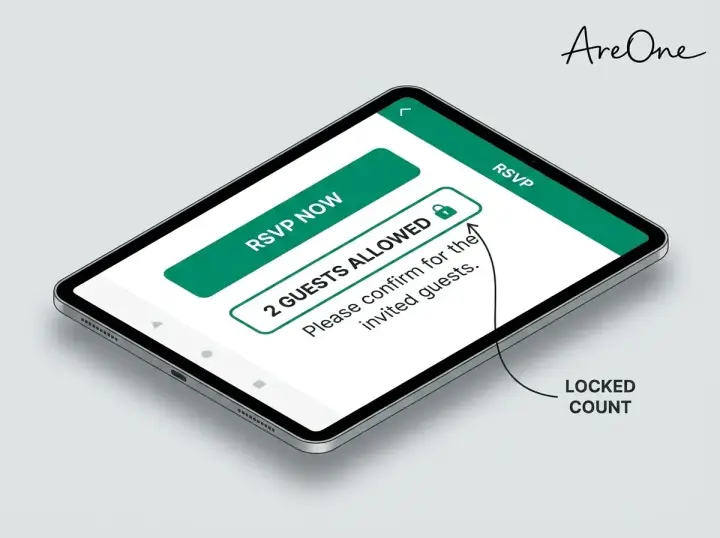
The Better Alternative: Address the invitation strictly to the names of those invited. For digital invites, use a sophisticated system that restricts RSVPs strictly to the named individuals, preventing unexpected plus-ones.
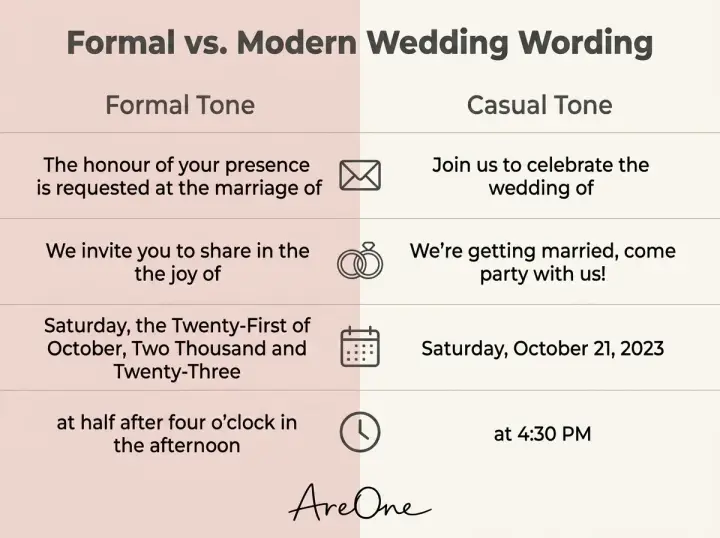
Comparison Table: Formal vs Casual Tone
Choosing the right vocabulary is a delicate balancing act. To help you visualize the difference in tone, we have created a helpful comparison table.
Use this table to translate your thoughts into the exact level of formality your unique celebration requires. Consistency is key; if you start formal, stay formal throughout the entire invitation suite.
| Element | Formal Wording Approach | Casual / Modern Wording Approach |
|---|---|---|
| The Request | "Request the honor of your presence" | "We’d love for you to join us" |
| The Action | "At the marriage of" | "As we finally tie the knot" |
| Date Format | "Saturday, the tenth of August" | "Saturday, August 10th" |
| Time Format | "At six o'clock in the evening" | "Starting at 6:00 PM" |
| Reception Info | "Dinner and dancing to follow" | "Drinks, tacos, and dancing after!" |
By comparing these directly, you can easily identify which column resonates more profoundly with your personal style and the atmosphere of the venue you have chosen.
How to Add Your Wording to a Digital Invite
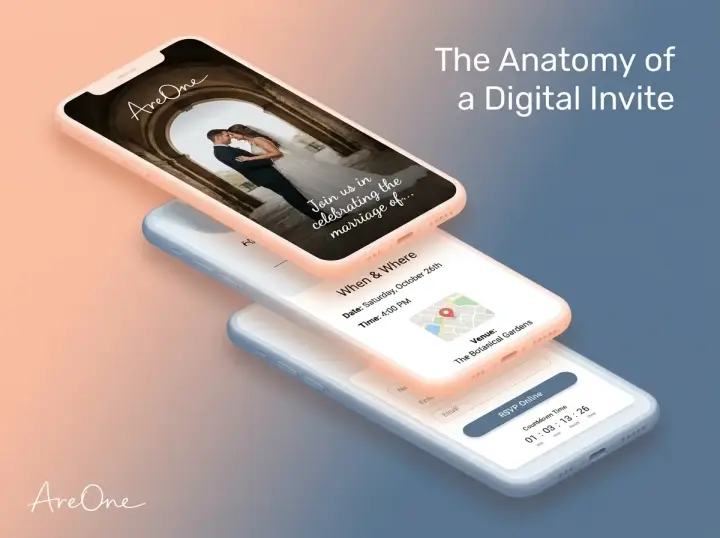
Once you have crafted your flawless phrasing, the next step is implementation. Digital invitations offer incredible flexibility, allowing you to present your words dynamically rather than cramming them onto a single piece of printed cardstock.
The layout of a digital invite usually follows a logical, scrolling flow. You want to place your primary wording right at the top in the 'Hero' section. This is the very first thing guests see when the page loads.
Your beautiful host lines, your names, and the primary request to attend should live here in a large, elegant font. It makes an immediate, powerful impact.
Below the hero section, you can utilize detailed text blocks to expand on the logistics. This is where you put the exact addresses, map links, and the dress code without disrupting the romantic wording at the top.
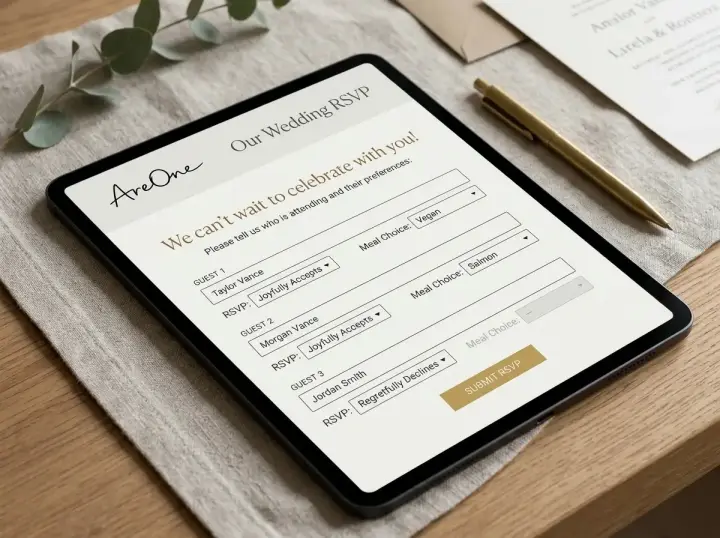
Finally, the wording naturally guides the guest toward the call to action. A brilliantly designed invite transitions from the romantic phrasing right into an interactive RSVP button.
Using a smart platform, you can customize the RSVP questions to gather meal preferences and dietary restrictions instantly. To learn more about how powerful this can be, explore our advanced wedding RSVP tracking features.
If you are worried about costs while designing these beautiful experiences, rest assured that creating a premium digital experience is accessible. You can review our transparent pricing plans to find a solution that fits your specific wedding budget perfectly.
Getting Your Wording Out of the Closet
Crafting the perfect LGBTQ wedding invitation wording doesn’t have to be a drag. In fact, it should be a fabulously clear, wonderfully empowering reflection of your unique union. By blending respectful etiquette with your own personal flair, you create an unforgettable first impression for your guests.
Embrace the freedom to rewrite the rules. Your love story is unlike any other, and the way you invite your favorite people to witness it should be just as spectacular. Put your unique signature stamp on every single sentence.
Let’s get your brilliantly written invites out of the draft folder and straight into your guests' inboxes. The celebration of a lifetime is just around the corner.
Frequently Asked Questions
Find quick answers to common questions about this article.
No approved comments yet.