
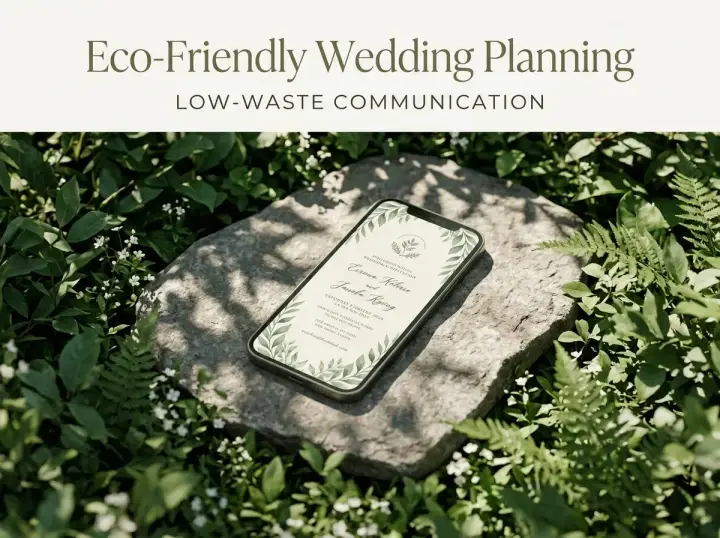
TL;DR: Eco friendly wedding planning starts with guest communication. Replacing a mailed paper suite with one digital invitation removes printing, envelopes, postage and reprints, and frees money for the day itself. Keep the design beautiful, the details clear, and a personal backup for guests who prefer a phone call.
What Makes Eco Friendly Wedding Planning Essential?
When you sit down to start your low waste wedding planning journey, the sheer volume of choices can feel overwhelming. Couples everywhere are realizing that beautiful celebrations do not require massive amounts of physical waste.
Eco friendly wedding planning is all about making mindful, intentional decisions that reduce your carbon footprint while maintaining the elegance and joy of your special day. One of the most significant areas where you can make an immediate, positive impact is through your guest communication strategy.
Traditional stationery sets involve save-the-dates, main invitations, RSVP cards, detail inserts, envelopes, and stamps. When you multiply that by a hundred or more guests, the physical waste accumulates rapidly. By shifting your focus toward low-waste alternatives, you protect the environment and dramatically streamline your own administrative tasks. You regain precious time that you can spend focusing on what matters: celebrating your love with family and friends.
The scale is real. As Brides notes, citing The Green Bride Guide, the average wedding in the United States generates about 400 pounds of garbage and 83 tons of carbon dioxide emissions, and the impact grows once the guest list passes 100 people.
If you are looking for comprehensive eco-friendly wedding invitation strategies, our dedicated pillar guide is the perfect place to explore the broader concepts. Taking the leap into paperless communication sets a modern, considerate tone for your entire event right from the start.
Browse invitation layouts that fit your plan.
Compare layouts for schedules, travel details, guest guidance, and RSVP information before choosing one for your invitation.



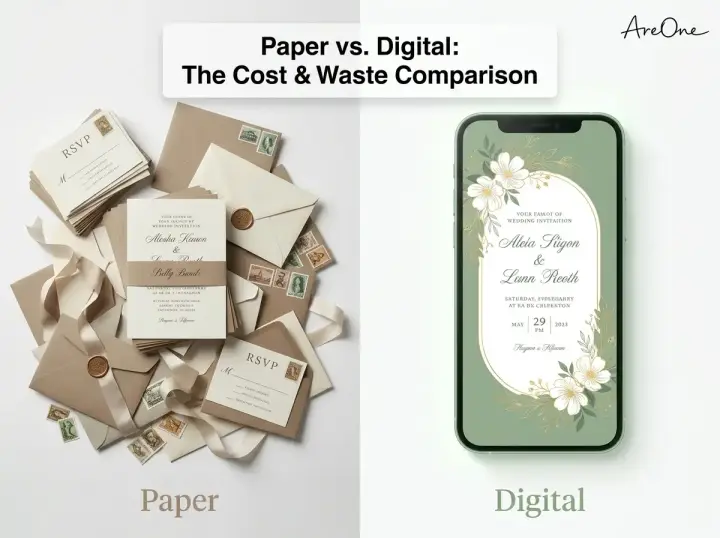
Cost Comparison: Paper vs Digital (Where You Save)
A paper invitation suite is really a stack of separate costs: design, printing, specialty finishes such as letterpress or foil, inner and outer envelopes, postage to every household and often a stamped return card for the RSVP. A digital invitation replaces most of that stack with a single link.
| Line item | Paper suite | Digital invitation |
|---|---|---|
| Design | Designer fee or a purchased template | A ready-made template you personalize |
| Printing and materials | Paid per piece, more for finishes and inserts | None |
| Envelopes and postage | Postage to every household, plus return stamps for RSVP cards | None: shared by link or QR code |
| Changes after sending | Reprint and re-mail the affected pieces | Edit once and every guest sees the update |
| RSVP tracking | Cards arrive by mail and are tallied by hand | Replies collect in one guest list |
Need a faster RSVP flow?
Use AreOne to collect guest replies, meal choices, and reminders in one clean workflow.
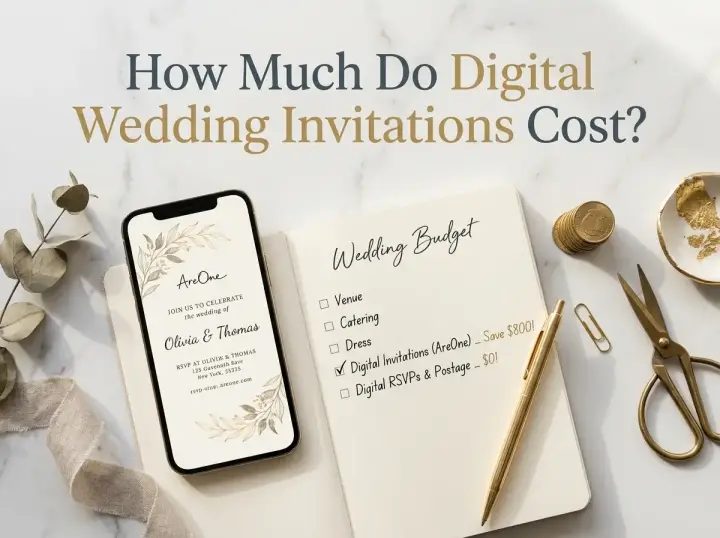
The exact gap depends on your guest count and how elaborate the suite is. For typical price ranges, see our breakdown of what digital wedding invitations cost, and check our pricing plans for what AreOne includes. Whatever you save can go toward the parts of the day your guests actually experience, such as the menu, the music or a shuttle from the hotel.
Recommended ReadingHow Much Do Digital Wedding Invitations Cost? A Stress-Free Breakdown →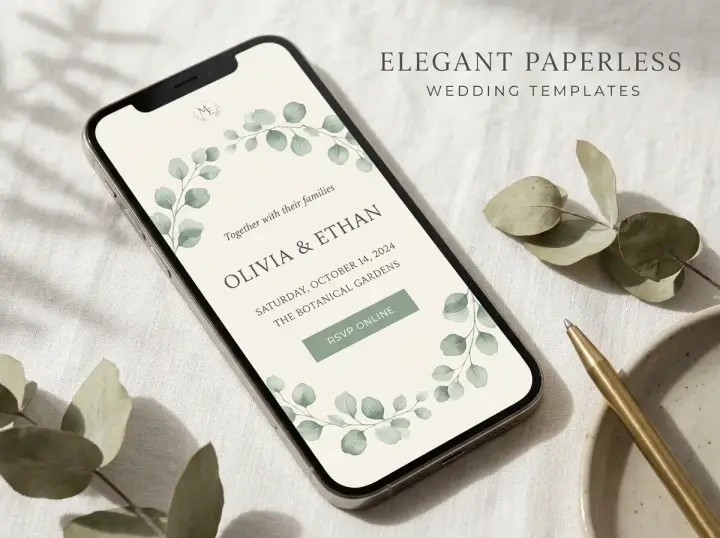
Eco Impact Basics: Waste, Shipping, and Reprints
Paper is the biggest single material in household trash. According to the EPA's paper and paperboard data, paper and paperboard were the largest component of U.S. municipal solid waste in 2018, at 67.4 million tons. Recycling helps, with a 68.2 percent recycling rate that year, but recycled stock still has to be pulped, printed and shipped. The most sustainable invitation is the one that is never manufactured.
Shipping is another contributor to your event's carbon footprint. Traditional invitations travel from the printer to you, and then from you to every guest. If guests are flying in for a destination wedding, that piece of paper may cross an ocean. A digital invite needs no physical transport at all.
Then there are reprints. If the venue changes, a time shifts or a typo slips past proofreading, paper invitations have to be printed and mailed again, which doubles both the waste and the cost. With a digital invitation you correct the detail once and everyone sees the current version.
The hidden footprint of a paper suite
The footprint goes beyond the card itself. Plastic sleeves protect suites in transit, and foil, glitter, vellum and wax seals can make pieces hard to recycle after the wedding. Recycled paper is a step in the right direction, but it still needs water, energy and delivery trucks. Low waste wedding planning starts by asking which pieces you need to print at all.
What Still Matters: Design, Clarity, and Guest Experience
Choosing a low-waste option does not mean compromising on elegance. Your invitation is the first glimpse guests get of your celebration's style, so a digital invitation should feel as considered as heavy cardstock. Browse our modern templates to see designs built for small screens without losing their romance.
Clarity matters just as much. Text should be easy to read on a phone, and the RSVP button should be obvious. Guests should find the venue address, dress code and timeline without scrolling through decoration. This is what sustainable wedding guest communication looks like in practice: one link that stays current instead of a stack of paper that goes out of date.
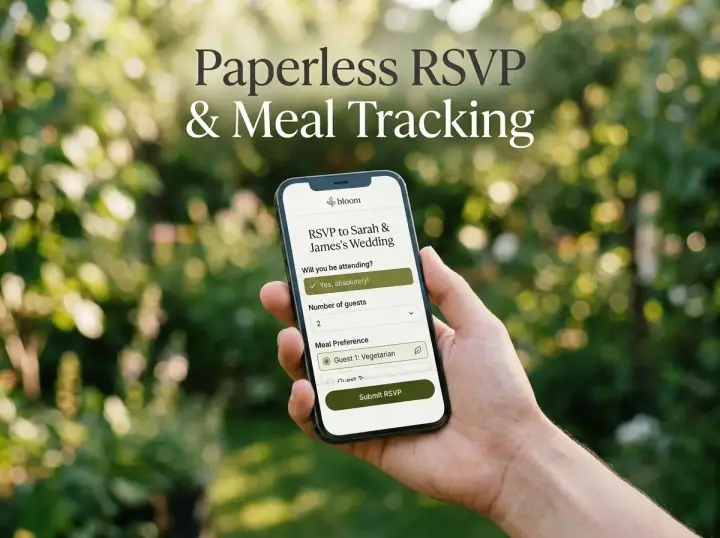
With online RSVP, guests answer attendance and meal questions in one short form, and their replies land in your guest list. If a grandparent would rather phone you, you can mark their answer yourself, so nobody is left out.
If your guests read different languages, a multilingual invitation lets everyone read the same details in their own language, without printing separate suites.
Budget-Friendly Plan: What to Spend On vs Skip
A little organization up front prevents last-minute purchases that create waste and stretch the budget. Use this plan to move your guest communication online smoothly.
Your low-waste communication checklist
- Collect contact details early: gather email addresses and phone numbers, and group households so each family gets one invitation.
- Write clear wording: spell out attire, plus-ones and children so guests do not have to guess.
- Test before you send: share the invitation with a parent or a friend first to check that the link works and the design looks right on a phone.
- Follow up personally: your guest list shows who has not replied yet, and a short personal reminder works better than another mailing.
Skip these
- Printed RSVP cards and stamped return envelopes
- Inner envelopes, vellum wraps, belly bands and wax seals
- Separate printed detail and accommodation cards
- A second print run after a change of plan
Spend here instead
- Food, drinks and the music your guests will remember
- Transport and accessibility for older or traveling guests
- One printed copy of your invitation to frame as a keepsake
A hybrid option for guests who love paper
Going paperless does not have to be all or nothing. Many couples send the digital invitation to most guests and print a small batch for the few who truly prefer paper, usually grandparents or a beloved great-aunt. Print those on recycled stock, skip the inserts and add a QR code that opens the same online invitation, so even paper guests can RSVP in seconds and see any later updates.
You keep one guest list, one set of details and only a handful of printed pieces instead of a full mailing. It is a gentle middle path that respects tradition while keeping waste to a minimum.
Wording to explain your paperless choice
Some couples worry that a digital invitation will feel informal. Wording sets the tone, so a sentence about your choice makes it feel intentional.
Formal: To celebrate our marriage while caring for the planet we share, we have chosen paperless invitations. We request the pleasure of your company and invite you to find every detail and your RSVP right here.
Casual: We are getting married! To keep things simple and low-waste, all our wedding details live here. Tap the button below to let us know if you can make it by [Date].
Three Mistakes to Avoid
Leaving older guests behind. Call grandparents and older relatives before the invitation goes out, explain what to expect and offer to record their reply for them.
Sending too late. No printing time does not mean no lead time. Keep the usual etiquette: save-the-dates months ahead and invitations about six to eight weeks before the wedding, earlier for destination weddings.
Assuming every message arrives. An emailed link can land in spam or go to an old address. Share the invitation through the channel each guest actually uses, and read our guide to keeping wedding invite emails out of spam.
Beyond Invitations: Small Low-Waste Choices
Your invitations are only the beginning. The same mindset works for flowers (local, in-season blooms arranged without floral foam), for catering (vendors who plan portions carefully and compost what is left) and for decor you can reuse or rent rather than buy.
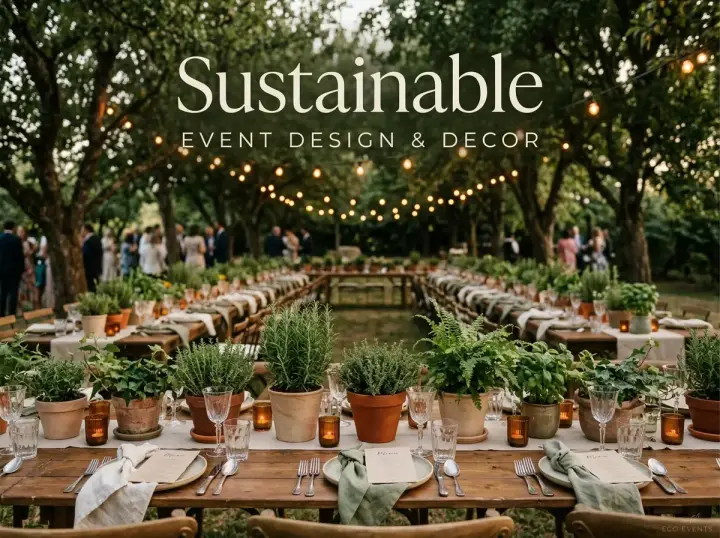
Planting the Seeds for Your Big Day
Eco friendly wedding planning is a series of small, deliberate choices, and guest communication is one of the easiest places to start. Replace the paper stack with one clear, beautiful invitation, keep a personal backup for guests who need it, and put what you save into the celebration itself.
Frequently Asked Questions
Find quick answers to common questions about this article.

No approved comments yet.